2025 Country Update
National PV Policy Programme
As Belgium is a federal state, the responsibilities for energy policy are divided among the three regions (Flanders, Wallonia, Brussels) and the federal Government, which is responsible for the renewable energy developments at the Belgian part of the North Sea.
In October 2025, the final national NECP was submitted. The regional ambitions are respectively 10/5.1/0.3 TWh of solar photovoltaic electricity generation by 2030 in Flanders, in Wallonia and in Brussels. Put together, this means a national generation target of 15.4 TWh/year (≈17 GW) by 2030 which falls short from the estimated 20-25 GW needed according to an EnergyVille study.
In 2025, there were no subsidies for new PV systems in Flanders, where competitiveness is driven by self-consumption, combined sales of surplus electricity to a utility, or by Power Purchase Agreements for larger plants. In Wallonia, there are not subsidies for new residential PV systems (<10 kW), for which competitiveness is driven by self-consumption combined sales of surplus electricity to a utility. For larger systems (>10 kW), green certificates can be obtained, even if the implementation of the new calculation method is suffering delays. The subsequent phase-out of net-metering in Flanders and then in Wallonia has also been accompanied with the increase of the combination of small-scale batteries and solar PV. Batteries connected to the distribution grid of the largest DSO in Belgium have risen from around 100 MW in 2021 to 740 MW at the end of 2024 (Elia). In Brussels, net-billing is in place for new residential PV systems (<5 kW) and green certificates are available for various sizes and typologies (BIPV-specific green certificate grant rate exists) of PV systems.
Since April 2025, consumers in all three regions are permitted to install plug-and-play solar panels. Although precise installation figures are not yet available, early indications suggest that this solution has rapidly gained popularity.
Across Belgium, solar integration obligations for buildings are increasingly linked to the EU recast Energy Performance of Buildings Directive. In Brussels and Wallonia, draft updates to regional building energy performance rules are considering how to include such solar requirements for new and existing buildings, with indicative deadlines for obligations falling within the 2027 to 2031 window depending on building type and size. The exact scope, exemptions and enforcement still need to be confirmed in 2026. In Flanders, alongside a reformulated ambition to accelerate the electrification of heating and transport, a specific obligation is already in place for large electricity users. Companies connected to a metering point withdrawing more than 1 GWh per year must meet a renewable energy obligation by 1 April 2026, following an extension from the initial 30th June 2025 deadline. The obligation can be met by commissioning PV, commissioning other renewables or related technologies, or by financial participation in renewable projects.
Research, Development and Demonstration
In 2025, Belgian PV research continued to align closely with the electrification pathway reaffirmed by EnergyVille’s updated PATHS2050 analyses.
These scenarios underline that deep electrification is indispensable for meeting Belgium’s climate objectives, with solar energy playing a structural role in the transition. Against this backdrop, Belgian RD&D remains strongly anchored in high-efficiency technologies – particularly perovskites and tandem architectures – while clearly shifting attention toward reliability, long-term validation, and industrial relevance.
Perovskites and tandems: durability becomes decisive – One of the most visible developments in 2025 was the shift from headline efficiency records to demonstrable operational stability. EnergyVille/imo-imomec and partners reported encouraging outdoor stability results for perovskite mini-modules, showing performance retention well beyond the short lifetimes that have historically limited confidence in the technology. By hosting both the tandemPV workshop and ISOS-16 in Genk, Belgium, it further confirmed its active role in shaping the international stability agenda. Discussions focused on degradation mechanisms, encapsulation strategies, measurement protocols, and improved data transparency – topics that are increasingly seen as prerequisites for bankability.
At the same time, Belgian research groups continue to publish strongly on perovskite and tandem PV, with particular attention to interface engineering, degradation pathways, and scalable processing. Importantly, these scientific advances are no longer viewed in isolation. Through initiatives such as NOAK (Next-of-a-Kind) PV and broader reshoring ambitions, Belgian actors are explicitly linking advanced PV concepts to manufacturing strategies and international value-chain partnerships, signalling a growing alignment between research excellence and industrial positioning.
Flexible thin-film PV and new application domains – Beyond tandems, Belgium continues to invest in lightweight and flexible thin-film PV, including chalcogenide-based technologies. Work on ultra-thin glass substrates and mechanically robust device architectures highlights opportunities for high specific power applications, ranging from vehicle integration and building façades to aerospace use. Increasing attention is given to reliability under demanding operating conditions, including temperature cycling and space-relevant stress factors. These efforts expand Belgium’s PV portfolio into high-value niches where performance-to-weight ratio and design flexibility are critical.
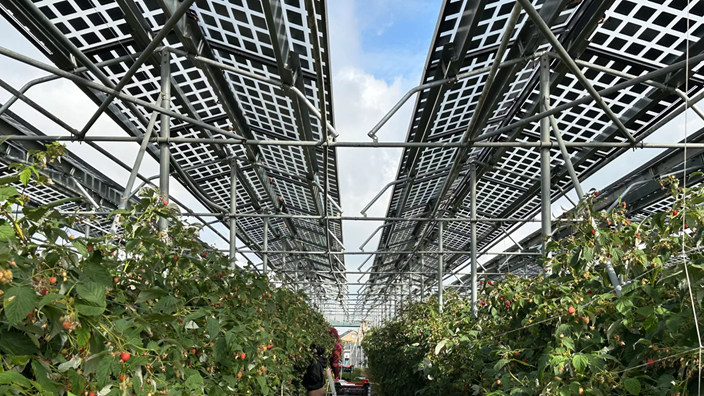
Agrivoltaics: from research concept to field practice – Agrivoltaics gained further momentum in 2025. EnergyVille/KU Leuven launched a practical web-based assessment tool within the Hyperfarm project to help stakeholders evaluate agrivoltaic configurations. The tool allows users to explore trade-offs between crop yield, shading effects, electricity production, and economic return, supporting informed project development. In parallel, field demonstrations – such as PV installations above fruit plantations in Sint-Truiden (PC Fruit) – illustrate that agrivoltaics is gradually moving beyond pilot status toward tangible deployment within Belgium’s agricultural landscape.
Demonstration infrastructure: IN2PV at Thor Park – On the demonstration side, Belgium strengthened its validation capacity with the launch of the IN2PV test infrastructure at Thor Park in Genk. UHasselt, imec, and Soltech inaugurated a 55-are outdoor facility dedicated to free-standing and building-integrated PV systems. The site enables long-term monitoring of novel module technologies – including tandem concepts – in realistic applications such as canopies, façades, noise barriers, and agrivoltaic systems. In this way, IN2PV forms a concrete bridge between laboratory innovation and deployable, system-level integration.
PV within large-scale energy missions – Finally, Belgian PV expertise is increasingly embedded in broader energy-system missions. In 2025, EnergyVille partners initiated a comprehensive study on the sustainable energy supply for the Einstein Telescope, the potential third-generation gravitational wave observatory in the Euregio Meuse-Rhine region. The study evaluates electricity demand during construction and operation, grid integration challenges, storage needs, and hybrid renewable configurations. Solar PV is positioned as a key building block in designing a credible, large-scale renewable energy solution, illustrating how Belgian RD&D contributes not only to technology development but also to energy-system integration at the infrastructure scale.
Industry and Market Development
In 2025, the total electricity consumption in Belgium was 80.1 TWh. Solar PV represented 15% (10.1 TWh) of the electricity generation mix in 2025, a 25% increase compared to 2024 primarily attributable to favourable sunshine conditions in 2025 as well as to the continued annual solar PV capacity additions in 2024 and 2025.
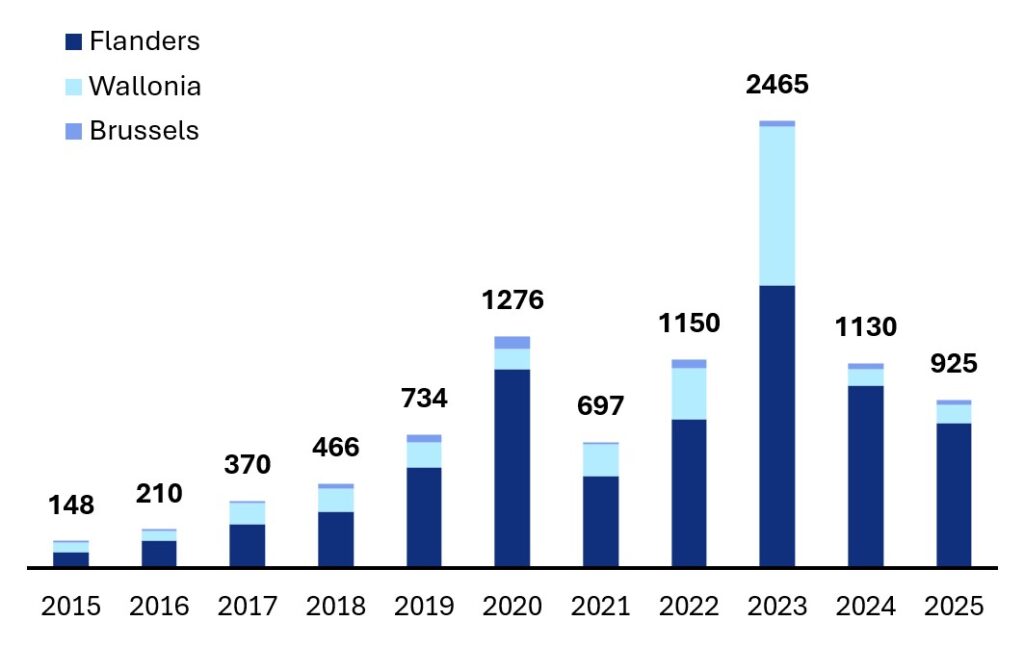
In 2025, the annual installed solar PV capacity is estimated to have been at least 925 MW, with respective contributions of Flanders, Wallonia and Brussels of 800 MW (estimation based on AC capacity), 100 MW and 25 MW. This brings the cumulative installed capacity close to 13 GW and Watt per capita penetration to 1 080. These figures should be treated as provisional, since full year data are not yet available for all regions. In recent years, reported annual totals have typically been revised upwards by 15 to 20 percent once final data are published, which could ultimately place the 2025 market closer to 1.1 GW.
There are just a few, niche-market, solar module producers in Belgium. BelgaSolar (called EvoCells until recently) added a new 50 MWp production line in 2024. Another example is Soltech, which targets the special use market of solar PV integrated in facades, glass, street furniture and stepping stones for instance. Their factory at a former coal mine site in Genk was officially opened in 2023 and shows a (solar PV) picture of a coal mine worker on their own façade. Belgium hosts a couple manufacturing projects, although these initiatives are not yet operational and remain at varying stages of maturity.
Participants from Belgium
EnergyVille – UHasselt
Energyville - KU Leuven
Task - 1
Energyville - KU Leuven
Task - 12
EnergyVille - VITO
Saeed RAHIMPOUR
Energyville - IMEC
Arvid VAN DER HEIDE
PV Cycle Association
Task - 13
EnergyVille – UHasselt
Nikoleta KYRANAKI
Patrizio MANGANIELLO
Lucisun
Jonathan LELOUX
Task - 15
Philippe MACÉ
EnergyVille – UHasselt
Nikoleta KYRANAKI
Lucisun
Jonathan LELOUX
Task - 16
Royal Meteorological Institute of Belgium (RMIB)
Hossein TABARI
Joris VAN DEN BERGH
Task - 17
Energyville - IMEC
MORLIER Arnaud
Task - 19
Energyville - KU Leuven