2025 Country Update
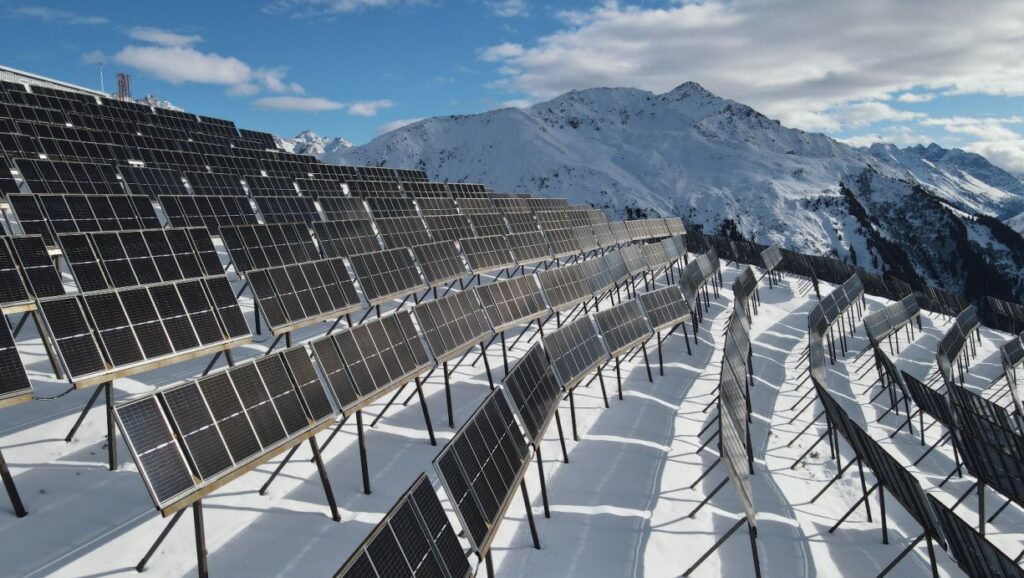
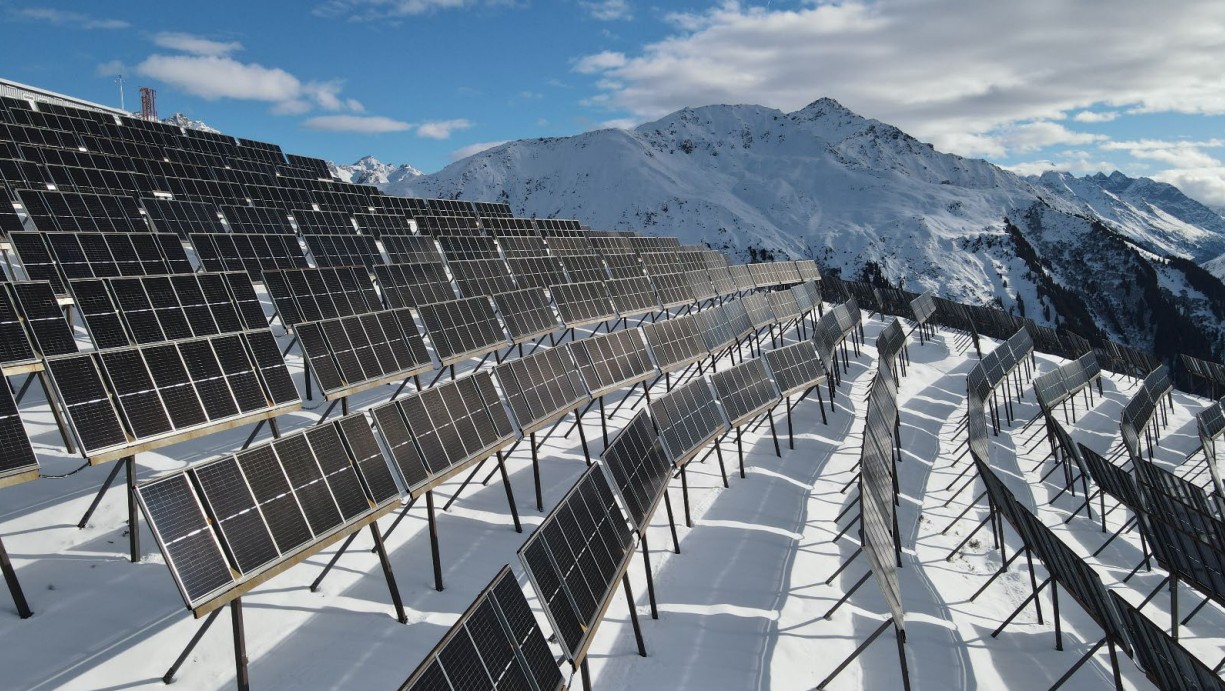
«Madrisa Solar», Switzerland’s first alpine large-scale photovoltaic plant located at around 2 000 m above Klosters, began feeding electricity into the grid in 2025 as part of the national «Solarexpress» (EKZ / Repower, 2025). Currently, about 15% of the installation is connected. Once fully built, the project will comprise approximately 20 000 bifacial modules of 580 Wp each, corresponding to an installed DC capacity of around 11 MWp. By 2027, the plant is expected to produce around 17 GWh annually, over 40% of it in winter, thus contributing to Swiss winter electricity supply. The total investment amounts to approximately 70 million Swiss francs (Photo: Madrisa Solar AG).
National PV Policy
During 2025, the staged implementation of the new Federal Electricity Supply Act shaped national PV policy. The first part of the ordinances entered into force on 1 January 2025, introducing a more flexible regulatory framework that expands possibilities for self-consumption.
This includes the use of low-voltage grid infrastructure at the grid connection point and the option to form virtual metering arrangements based on the smart metering systems operated by distribution grid operators. The objective is to reduce administrative complexity, broaden access to self-consumption and create more uniform and predictable conditions for PV deployment.
Stakeholders noted that the transition toward the new regulatory framework brought temporary uncertainties, particularly regarding remuneration rules, metering concepts and evolving administrative procedures. As the new legal instruments began to take effect, grid operators and project developers had to adapt internal processes and customer interfaces, resulting in a period of adjustment throughout 2025.
According to the Federal Act on a Secure Electricity Supply from Renewable Energy Sources, interim targets for the expansion of renewable electricity production must be defined every five years to ensure progress toward the legally binding expansion targets (35 TWh by 2035 and 45 TWh by 2050, excluding hydropower). With the amendment of the relevant ordinance on 1 January 2026, these interim targets were defined for the first time. By 2030, renewable electricity production is to reach 23 TWh, of which 18.7 TWh are expected from solar photovoltaics and 2.3 TWh from wind power. These targets are demanding, as doubling today’s PV production of just over 8 TWh must be achieved within four years.
Several policy elements scheduled to take effect on 1 January 2026 already influenced planning practices in 2025. These include the introduction of the Winterstrombonus (winter electricity bonus) under the revised Energy Promotion Ordinance (EnFV), which supports PV systems with high winter output. It replaces the previous Solarexpress and provides targeted support for systems above 100 kW that achieve high specific winter yields. While the earlier scheme applied a fixed threshold of 500 kWh/kW and allowed investment contributions of up to 60%, the new Winterstrombonus is a variable, performance-based incentive calculated on the specific winter yield above the 500 kWh/kW reference value. As it modifies existing investment contribution and market premium mechanisms rather than introducing a separate subsidy level, overall support is less generous and more differentiated than under the Solarexpress.
The Local Electricity Communities (LEG) framework will also enter into force in 2026. It will enable local trading of PV electricity within the same grid level and municipality, applying reduced tariffs for locally consumed electricity and thereby supporting more decentralised cooperation models.
A further regulatory innovation concerns the introduction of dynamic grid usage tariffs from 2026 onward. Network charges will vary over time, being lower during periods of high electricity availability and higher during grid congestion. This is intended to create incentives for consumption patterns that better align with system conditions. An overview of the tariff models is available here.
Overall, 2025 marks a year of regulatory transition and market adjustment. The combination of the new Electricity Act, the forthcoming 2026 instruments and ongoing discussions on future electricity cooperation with the EU provides the strategic framework for PV deployment in the coming years.
Research, Development and Demonstration
According to Swiss energy research statistics, CHF 40.94 million in public funds were allocated to photovoltaics research in 2024. This amount represents 10.6% of total public expenditure on energy research in Switzerland and 43.9% of all public funding directed toward renewable energy sources. Data for 2025 have not yet been released.
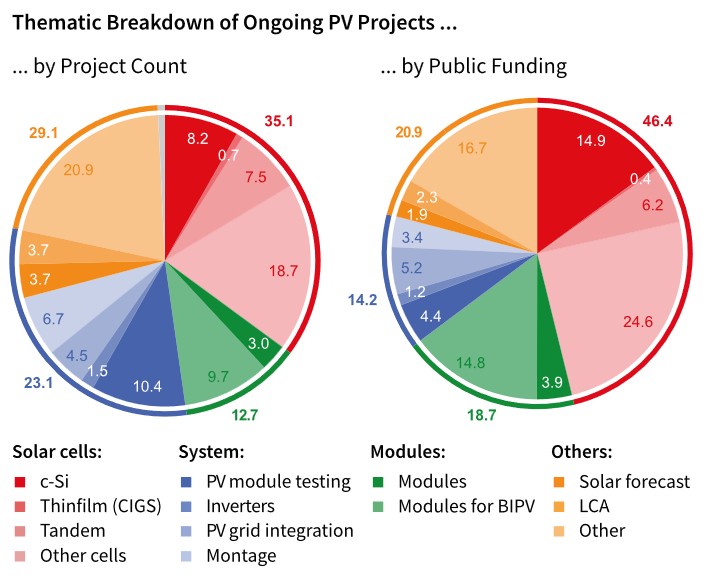
The chart below provides an overview, as of 27 February 2025, of the number of projects and the associated financial commitments, disaggregated by subject area (source: https://pv.energyresearch.ch). A total of 97 research and demonstration projects are currently underway. Compared to 2024 (last year’s report), the share of public funding allocated to solar cell research has decreased slightly, from 57.9 percent in 2024 to 46.4 percent in 2025.
According to official statistics for 2024, 39 per cent of photovoltaic projects—measured by the volume of public funding—received support through European cooperation. Funding provided via the Swiss Federal Office of Energy’s PV programme accounts for a little over 9 per cent, but will decline in future due to the discontinuation of the pilot and demonstration funding line (see below). In 2025, some 20 per cent of the SFOE’s available funds for PV research were allocated directly to IEA PVPS Task projects, complemented by numerous SFOE‑funded and other national and European projects that contribute to the various research topics within IEA PVPS.
The government’s proposed measures (Relief Package 27) to achieve a balanced federal budget in the coming years — currently under discussion in Parliament — include broad austerity steps that also affect federal support for research. Energy research funding is among the areas concerned, with the funding line for pilot and demonstration projects at the Swiss Federal Office of Energy being discontinued. These developments are expected to have a corresponding impact on national photovoltaic research.
Industry and Market Development
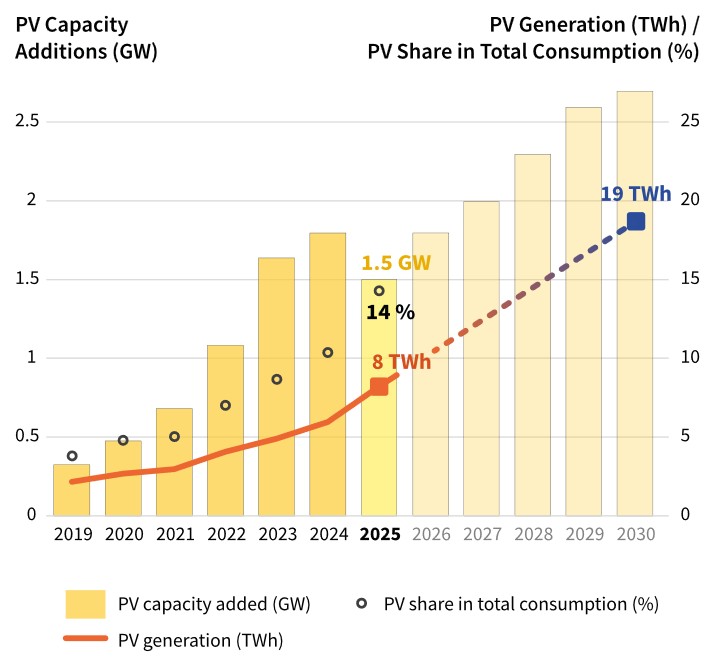
According to Swissolar, the national solar association, the industry has entered a phase of consolidation after several years of rapid expansion. Following another record year in 2024 with 1.8 GW of newly installed capacity, a slight decline to around 1.5 GW of newly installed capacity is expected for 2025, according to Swiss Solar Monitor)
Despite this slowdown, expansion remains at a high level and must continue in order to achieve the ambitious targets for 2030. By the end of 2025, solar energy is projected to cover around 14 per cent of final electricity consumption. With an annual production of more than 8 TWh, it has become systemically relevant, and its contribution continues to increase. Current assessments underline the scale of the required expansion: according to Swissolar, annual additions on the order of around 2 GW and increasingly more towards the end of the decade will be necessary to reach the 18.7 TWh PV production target for 2030. Sustained high installation rates are essential to remain on track for the 2030 and 2035 milestones.
The market structure continues to be shaped overwhelmingly by rooftop PV systems. Small and medium‑sized installations account for the largest share of cumulative capacity, and larger commercial rooftop systems also represent a significant proportion of the market. Other application types such as façade systems, infrastructure‑integrated PV, alpine installations or Agri‑PV currently contribute only marginally to total installed capacity.
Participants
Task - 12
Zurich University of Applied Sciences (ZHAW)
Matthias STUCKI
Task - 13
CSEM PV-Center, EPFL Photovoltaics Laboratory
Alessandro VIRTUANI
University of Applied Sciences and Arts of Southern Switzerland (SUPSI)
Bert HERTELEER
Gabi FRIESEN
Task - 15
HES-SO Geneva (HEPIA)
Gilles DESTHIEUX
Megasol
Thomas FRIESEN
University of Applied Sciences and Arts of Southern Switzerland (SUPSI)
Fabio PAROLINI
Pierluigi BONOMO
Task - 16
Eastern Switzerland University of Applied Sciences (OST); Institute SPF
Evelyn BAMBERGER
HALLER Michel
Meteotest
Task - 19
Meteotest
University of Applied Sciences and Arts of Southern Switzerland (SUPSI)