2025 Country Update
National PV Policy
The Integrated National Plan for Energy and Climate (PNIEC), bolstered by various initiatives under the National Recovery and Resilience Plan (PNRR), serves as the definitive framework for advancing energy decarbonization in Italy.
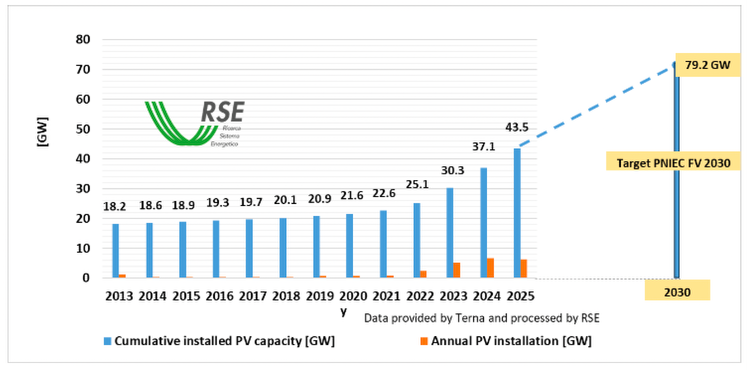
In 2024 the PNIEC was revised to strengthen the targets for 2030, aligning with the objectives of the Fit for 55 package and the REPowerEU strategy. The updated framework increases the share of Recovery and Resilience Facility funds allocated to climate-related objectives from the original 37% to approximately 39-40%. The primary objective for 2030 is to achieve a 39% share of renewable energy sources (RES) in gross final energy consumption. , Achieving this objective will require a significant expansion of photovoltaic (PV) capacity, reaching 79.2 GW of installed capacity and generating 97.6 TWh of electricity annually. While the trajectory of PV installations appears to be progressing in accordance with the required advancements in photovoltaic deployment, challenges persist in securing the necessary permits for installation, despite the costs being competitive enough to enable market parity for PV plant installations. In 2025 in Italy has been added 6.4 GW of PV capacity, reaching 43.5 GW of cumulative capacity (+22% compared to 2024).
Below are some of the main measures to support PV installations:
a) Economic support
-
- The tax relief mechanism for the installation of residential systems reimbursing 50% of the photovoltaic installation costs up to a maximum cost of €96 000 per residential unit. A feed-in tariff mechanism, provided by Ministerial Decree, is in place for supporting less renewable energy technologies, such as biomass, biogas, geothermal energy and offshore wind
- A premium tariff for shared and self-consumed energy in the Renewable Energy Communities (CER), thanks to the decree that increased the single plant power limit to 1 MW and enlarged perimeter to primary electric station
- Access to the 40% non-repayable grant, previously limited to CER project located in Municipalities with a population up to 5 000 inhabitants, has been extended to include CER with production plants located in Municipalities with a population up to 50 000 inhabitants.
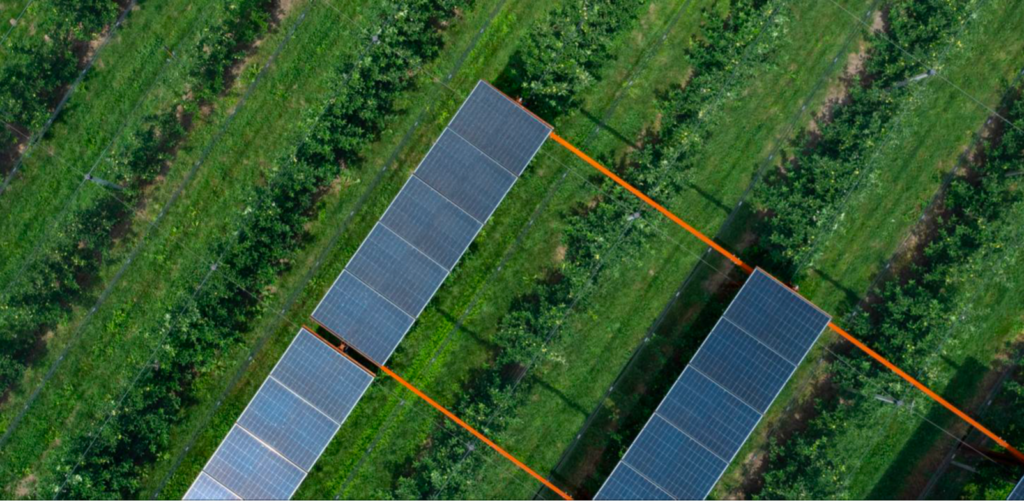
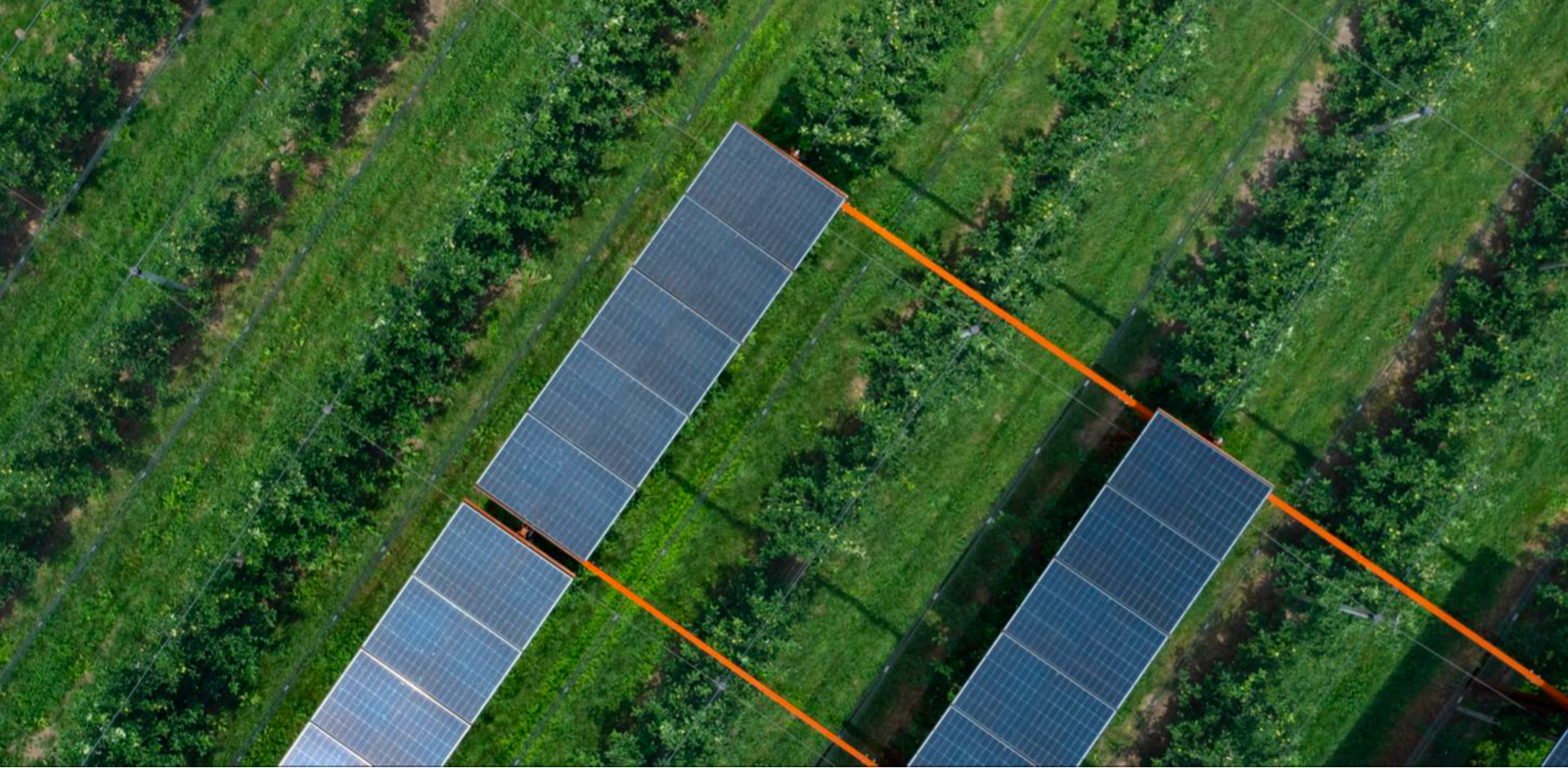
- The extension of the PNRR investment promoting advanced Agri PV (with certain requirements in terms of height from ground and monitoring systems) developed by agricultural companies (or temporary associations between investor and agricultural companies), composed of an incentive tariff granted for 20 years and capital contributions up to 40% of the investment costs (competitive auctions have been called)
- PNRR investment to support industrial decarbonisation and strategic clean-energy supply chains (PV, wind, batteries, heat pumps, electrolysers and carbon capture technologies).
- A feed-in tariff mechanism, provided by Ministerial Decree, has been enacted for supporting “mature” RES (PV plants, on shore wind and so on), with two auctions having been called in 2025, one which dedicated to NZIA projects.
b) Structural reforms for an easier market penetration.
-
- Environmental permitting procedures for renewable energy plants were further simplified in late 2025 through amendments to the TU FER (2024), aiming to streamline and accelerate authorization processes
- Fast-track authorization procedures have been introduced for renewable energy projects in designated “suitable areas”, including abandoned industrial sites, degraded lands, and former quarries and mines. Regional criteria for identifying these areas were revised in 2025 and are currently being implemented.
- Agrivoltaics has been defined at legislative level, requiring the continuation of agricultural activities on site and, where necessary, the use of elevated modules and digital or precision farming tools.
Research, Development and Demonstration
To achieve the ambitious goals of the National Integrated Energy and Climate Plan (PNIEC) and the National Recovery and Resilience Plan (PNRR), research and innovation activities are focused on next-generation photovoltaic technologies and integrated solutions that support the national energy transition.
Research and innovation in the renewable energy sector play a dual strategic role: they support the integration of renewable electricity into the National energy system while strengthening a competitive domestic value chain and delivering economic and environmental benefits.
Within this framework, research activities focus on advanced materials and device architectures aimed at improving the performance of photovoltaic technologies, including crystalline silicon, heterojunction, CIGS, and perovskite-based solar cells. Particular attention is devoted to high-efficiency tandem concepts, such as perovskite/silicon monolithic two-terminal devices. Research also explores wide-bandgap perovskite films for single-junction, tandem, and triple-junction configurations, as well as the integration of silicon with III–V compounds and nitride-based thin films. Parallel activities focus on optimizing the energy production and reliability of photovoltaic (PV) systems. This includes the integration of AI-based tools into Operation and Maintenance (O&M) strategies, enabling the remote detection of underperformance and faults and supporting the transition toward advanced digital O&M approaches. Particular attention is also given to bifacial tracking systems, in the optimization of tracking algorithms and measures to maximize the annual energy yield. Land-use optimization and multifunctional integration remain central pillars of the research programme. Beyond agrivoltaic and floating PV solutions already under development, activities include the design and fabrication of organic and dye-sensitized solar cells (DSSC) engineered to selectively transmit specific portions of the solar spectrum required for plant growth. Furthermore, new agrivoltaic concepts are being explored, including innovative “algovoltaic” configurations that combine conventional ground-mounted PV systems with photobioreactors for microalgae cultivation. Resilience under climate change is also an integral component of the research agenda. As extreme weather events become more frequent and intense, dedicated studies investigate the vulnerability of PV systems to these events, identifying innovative mitigation measures to enhance system robustness and long-term performance stability. In this context, the Research Fund for the Italian Electrical System (RdS), financed by the Ministry of the Environment and Energy Security (MASE) and supported by the PNRR, provides substantial funding for research, development, and demonstration activities related to innovative photovoltaic technologies, involving several research institutes and PV operators.
Among them, ENEA focuses on high-efficiency solar cells based on perovskite/c-Si tandem structures, module ecodesign, the digitalization of PV systems, and the conceptualization and promotion of “Sustainable Agrivoltaics,” also through the realization of demonstrators. Furthermore, RSE SpA, is carrying out research activities on: (1) multi-junction PV cells; (2) III–V compounds and nitride-based thin films deposition on silicon for tandem applications; (3) advanced PV plant O&M strategies aimed at optimizing production through anomaly detection and fault recognition techniques, including the sharing of a dedicated public fault-data repository; and (4) Life Cycle Assessment (LCA) of the most promising innovative PV technologies.
Other major research organizations include CNR, which is active in the evaluation of innovative low-cost thin-film processes on silicon cells, and EURAC Research, which works on improving PV plant performance and reliability as well as on Building Integrated Photovoltaics (BIPV). Additional contributions are provided by several university laboratories, including the CHOSE Centre of the University of Rome Tor Vergata, the University of Milano-Bicocca, and the University of Turin, as well as by PV industry operators covering the entire value chain, from cells and modules to inverters and tracking systems.
It is also important to mention ReteIFV – the Italian Network for Research, Development and Innovation in Photovoltaics – which promotes coordination and knowledge sharing among research institutions, universities, and manufacturers of PV components and systems, supporting collaborative initiatives and shared research infrastructures at the national level.
Industry and Market Development
The Italian PV industry includes companies operating in the major segments such as BIPV, BAPV and electric mobility (VIPV), with a strong focus on innovative and high-efficiency module technologies. National manufacturing experienced significant growth in recent years, driven by major investments and new production facilities.
A key development is the expansion of Enel Green Power’s 3SUN factory in Catania, which is planned to reach a total capacity of 3 GW per year at full operation.
FuturaSun, within the framework of the FENICE project funded by Innovation Fund, plans to establish a new PV module manufacturing plant in Veneto with an initial production capacity of approximately 2 GW per year, designed for future expansion. The manufacturing plant will be focused on advanced n-Type and xBC technologies. In parallel, FuturaSun acquired Solertix, a spin-off from the CHOSE -Centre at the University of Rome Tor Vergata-, specializing in perovskite–silicon tandem technologies. Other investments include DAX Solar’s 600 MW facility in Lazio, producing high-efficiency PERC and TOPCon modules, and the near completion of Midsummer Italia’s 50 MW CIGS thin-film factory in Bari, introducing lightweight, flexible modules for industrial roofs and mobility applications.
In the field of mounting structures for PV modules, several Italian companies specialize in the development of single-axis trackers for utility-scale applications, including Convert Italia (a Valmont Industries company), Comal, AcriGroup, REM Tec, RCM Italia, and Soltigua. Among them, Convert Italia, Comal, and REM Tec also supply tracker systems for agrivoltaic installations.
Ecoprogetti, a leading company in the design and assembly of production machinery and quality control systems for PV modules, launched – already in 2024 – a fully automated solar panel recycling line capable of recovering up to 100% of key materials without the use of chemical treatments, providing a scalable and economically viable solution to the growing challenge of PV waste management.
These developments highlight a dynamic and evolving Italian PV supply chain, positioning Italy to play an increasingly relevant role in the European PV value chain. However, smaller manufacturers have experienced declining production due price competition from Asian suppliers, highlighting the need for sustained investment in innovation, quality, and advanced services to remain competitive.
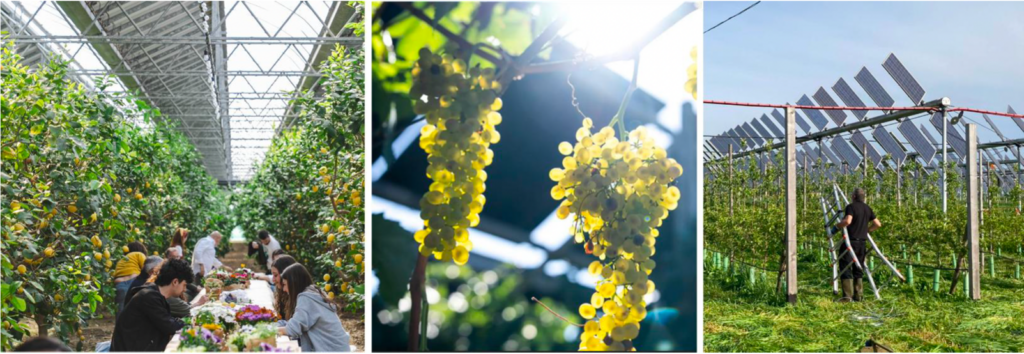
Within this evolving PV ecosystem, agrivoltaics (APV) is emerging as one of the most promising market segments. Agrivoltaics in Italy has evolved from small research installations to a rapidly expanding sector supported by national guidelines and incentive schemes under the National Recovery and Resilience Plan (PNRR). The technology is considered a strategic solution for PV deployment, as it helps address land-use and landscape constraints while maintaining agricultural activity. Its importance is expected to increase further following Law 15 January 2026 n.4 (conversion of Law Decree n.175/2025), which establishes that only agrivoltaic installations are permitted in agricultural areas.
National studies estimate a technical potential between 50 and 70 GW of agrivoltaic capacity (according to reports published by RSE 2022; ENEA 2023). Operational installations remain limited but are steadily increasing, with several pilot and pre-commercial systems typically ranging from 0.5 to 5 MW, showing electricity yields comparable to conventional ground-mounted PV systems (around 1 300–1 600 MWh/MW/year, depending on location).
The first two national PNRR agrivoltaic calls (2024–2025) admitted 747 projects for approximately 2.0 GW, nearly double the initial target of 1.04 GW. The scheme supports “experimental” agrivoltaic projects, as defined by Ministerial Decree n.436/2023, emphasizing the innovative role of APV in strengthening the resilience and sustainability of the agricultural sector.
Beyond the PNRR scheme, the agrivoltaic pipeline is significantly larger. Studies indicate more than 50 GW of projects currently awaiting authorisation, confirming the strong interest in agrivoltaics as a dual-use solution combining renewable electricity generation with agricultural production.
Participants
National Agency for New Technologies, Energy and Sustainable Economic Development (ENEA)
Alessandra SCOGNAMIGLIO
Ricerca Sistema Energetico (RSE S.p.A.)
Task - 1
Gestore dei Servizi Energetici (GSE S.p.A.)
Francesca TILLI
Ricerca Sistema Energetico (RSE S.p.A.)
Andrea DANELLI
Task - 12
Ricerca Sistema Energetico (RSE S.p.A.)
Andrea DANELLI
Task - 13
European Academy Bozen/Bolzano (EURAC)
Luis André PEREIRA FIALHO
Sandra GALLMETZER
Gestore dei Servizi Energetici (GSE S.p.A.)
Francesca TILLI
Ricerca Sistema Energetico (RSE S.p.A.)
Sapienza University of Rome
Leonardo MICHELI
Task - 15
European Academy Bozen/Bolzano (EURAC)
Gabriella GONNELLA
Jennifer ADAMI
Laura MATURI
Gestore dei Servizi Energetici (GSE S.p.A.)
Francesca TILLI
Politecnico Milano
Claudio DEL PERO
University of Naples Federico II
Enza TERSIGNI
Valeria D’AMBROSIO
Task - 16
European Academy Bozen/Bolzano (EURAC)
Marco PIERRO
National Agency for New Technologies, Energy and Sustainable Economic Development (ENEA)
Irena BALOG
Ricerca Sistema Energetico (RSE S.p.A.)
Dario RONZIO
Elena COLLINO
University of Rome II - Tor Vergata
Cristina CORNARO
i-em
Ciro LANZETTA
Task - 19
National Agency for New Technologies, Energy and Sustainable Economic Development (ENEA)
Giovanna ADINOLFI
University of Catania
Rosaria VOLPE
Task - AG
National Agency for New Technologies, Energy and Sustainable Economic Development (ENEA)