2025 Country Update
National PV Policy
Singapore is a signatory to the Paris Agreement and has committed to achieving net-zero emissions by 2050.
The nation’s “Energy Story” outlines four supply switches – natural gas, solar PV, regional power grids and low-carbon alternatives – to transform and decarbonise the energy sector. These measures align with Singapore’s broader sustainability agenda, including the SG Green Plan 2030. The nation’s installed PV capacity (DC) is now at more than 1.7 gigawatt-peak and is growing steadily.
The Solar Energy Research Institute of Singapore (SERIS) supports the country’s energy transition by developing and commercialising solar technologies tailored to urban, tropical environments, and by fostering industry development and wider solar adoption. A major constraint for PV deployment in the City-state is land scarcity. SERIS addresses this by researching solutions that enable multiple uses of limited space, such as building-integrated PV (BIPV), floating solar, agrivoltaics (dual use of PV and crop production), and solar canopies over existing infrastructures like car parks and flood canals.
Research, Development & Demonstration
SERIS, with its 110 research staff is active from cells to systems.
Some of the highlights in 2025 were:
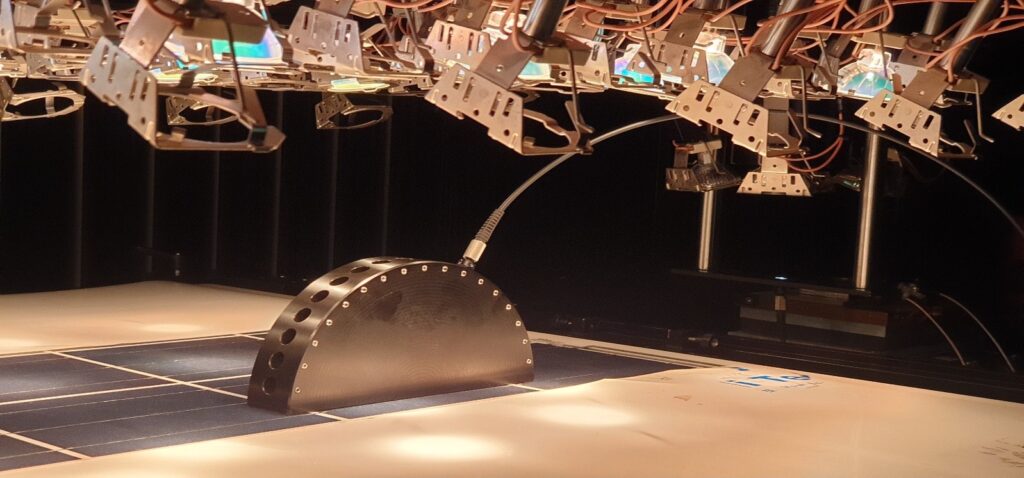
- The solar cell flagship project continued to advance rapidly. Our single-junction perovskite cells (1 cm²) reached an efficiency of 26.6%, while our 2-junction perovskite-Si tandem devices improved to 33.3% (1 cm²). The efficiencies of 16-cm² and 244-cm² 2-junction perovskite-Si tandems improved to 28.2% and 24.1%, up from 25% and 20% a year earlier. These figures are among the highest reported by public research institutions for these device classes. We also converted the large tandem cells into glass-glass single-cell mini-modules, raising module efficiency to more than 21%. Together, these results strengthen our pathway to the project target of 30% efficient mini-modules with an active area of at least 150 cm² by March 2027. Our team also made a perovskite-organic 2-junction tandem cell (1 cm2) with 26.4% certified efficiency, which is a new world record.
- As part of the BIPV flagship project, an entire BIM (building information modelling) workflow was created for adding BIPV products to the overall BIM framework. This includes 3D modelling, PV layouts, energy yield projections and life cycle cost assessments.
- SERIS published on its findings on the global status and potential of both inland reservoirs (including water savings from reduced evaporation) and off-shore sea spaces. The paper shows that utilising merely 10% of the techno-economic areas could power the entire world today, and even a future 100% renewable energy scenario.
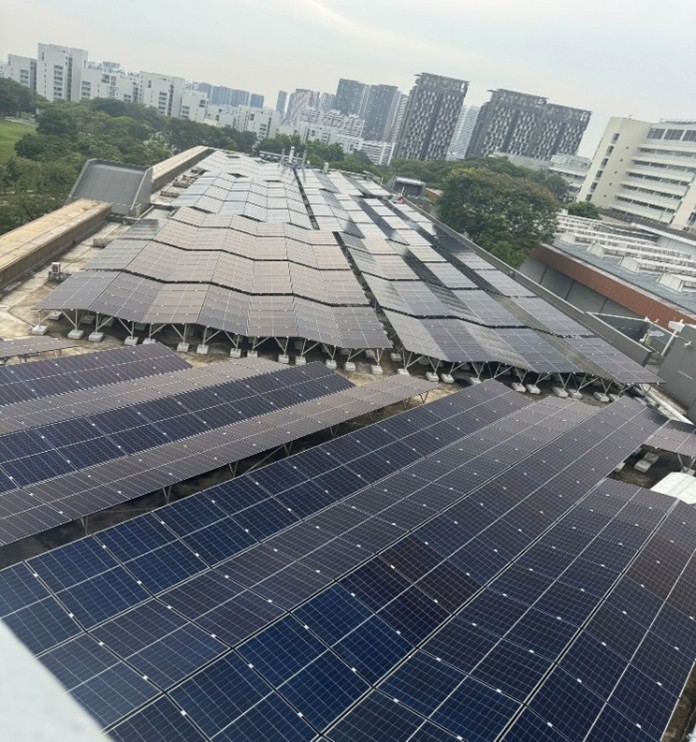
- NUS and SERIS implemented a 600 kWp system on one of the campus buildings to achieve net-zero energy usage by retrofitted building. In addition the project will allow the study of LCOE of high efficient modules. This system is the last addition to the 10 MW solar PV systems already deployed on campus.
Industry and Market Development
Working with and for industry is one of the key objectives of SERIS.
In 2025 these projects can be specially mentioned:
- The REC@NUS Corporate Laboratory project made strong progress with establishing a new R&D pilot line at SERIS for ultra-large (up to 440 cm2, G12 wafer size) 30% perovskite-silicon tandem solar cells using an ultra-fast perovskite deposition process. This pilot line will be ready for R&D in Q1 2026. Using existing labs at SERIS, the Corporate Lab team achieved tandem cell efficiencies of about 25% for 244-cm2 devices, confirming the robustness and potential of our technology.
- SERIS signed a MoU with company Geoharbour to jointly develop novel deployment solutions for their ~20% efficient single-junction perovskite solar foils, which open fundamentally new opportunities for integration into the urban fabric (e.g. large-scale over-arching solar canopies).
- SERIS spin-off PV Doctor Pte Ltd, a PV asset performance management and smart O&M company, had a flying start and managed to sign up more than 1 GWp of ‘Assets under Management’ (AUM) across 1 300+ sites in 21 countries within its first year, demonstrating strong global reach and establishing itself as one of the fastest-growing digital asset-intelligence platforms in the solar industry.
Participants
Task - 13
Task - 15
Solar Energy Research Institute of Singapore (SERIS)