2025 Country Update
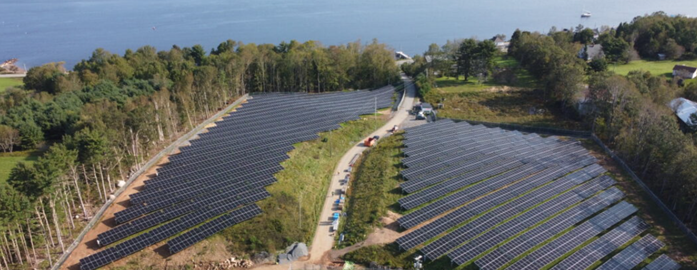
Inaugurated in January 2024, the 4.8 MW community-owned PV array in Mahone Bay, Nova Scotia, is part of the province’s Community Solar Program which facilitates shared ownership of PV projects. The array was partly funded by the Government of Canada, and the project was developed by AREA, a 100% municipally owned company formed in 2014 (photo credit: Goldbeck Solar).
National PV Policy
The development of the photovoltaic (PV) sector in Canada fits within the broader context of efforts to decarbonize electricity production. There are no specific capacity installation targets for PV set by the federal, provincial, or territorial governments.
As of December 31, 2024, Canada’s PV sector reached approximately 7.35 GWDC of installed capacity, representing a 4% increase (or around 299 MWDC) over the previous year. These data and other information on PV policy, prices, and industry trends are reported in Canada’s annual National Survey Report (NSR) provided to the International Energy Agency Photovoltaic Power Systems Program.
At the national level, PV is eligible for several federal support programmes including the CAD 4.56 billion Smart Renewables and Electrification Pathways Programme, the CAD 500 million Low Carbon Economy Fund, the CAD 520 million Clean Energy for Rural and Remote Communities programme, and the CAD 100 million Smart Grid programme. There are also tax incentives for Canadian industry including, more recently, Canada’s Clean Technology Manufacturing (CTM) Investment Tax Credit which refunds 30% of the capital costs for new machinery and equipment used to manufacture low carbon technologies or to extract minerals and other resources used in their fabrication. The CTM credit is available to eligible property that was acquired between January 1, 2024, and December 31, 2034. Provinces and territories also implement their own local support policies such as capital subsidies, self-consumption, net metering, and Property Assessed Clean Energy programmes whereby PV costs are repaid through property taxes.
Research, Development and Demonstration
Fundamental materials research into PV cell or module technology is conducted primarily through university and industry research groups, while research, deployment, and optimization of PV systems tend to be the purview of industry, local utilities, and governmental institutions.
At the Federal level, PV systems research and deployment occurs mainly through the Renewable Energy Integration (REI) programme of CanmetENERGY in Varennes. To this end, the REI program conducts PV research on the performance, durability, and costs of PV systems and components as well as their integration into buildings and electricity grids. CanmetENERGY also studies PV system applications in remote Arctic communities in Nunavut, Yukon, Northwest Territories, and the northern Quebec region of Nunavik. Renewable energy deployment in these communities reduces diesel fuel dependence while increasing grid flexibility and energy storage options.
Aside from the installation of ground-mounted and rooftop PV systems, there is also interest in agrivoltaics among Canadian PV installers, project developers, and farmers. More work is needed to promote research, develop case studies for different crops and PV configurations, establish regulatory frameworks, and define and implement policy support mechanisms. Agrivoltaics Canada, a farmer-led not-for-profit advocacy group, was recently incorporated to help realize these goals. Agrivoltaics Canada works in partnership with the PV industry, as well as with provincial and federal government agencies and academic institutions including the University of Western Ontario and the Ontario Agricultural College at the University of Guelph.
Industry and Market Development
Total PV electricity production as a percentage of total electricity consumption in Canada is around 1.4%.
In terms of DC capacity, approximately 73% of Canada’s cumulative PV capacity consists of ground-mounted centralized systems providing bulk power on the supply side of electricity meters without self-consumption. The remaining 27% is distributed PV capacity on the demand side of the electricity meter and often embedded on a customer’s premises. The economic value of the Canadian PV industry in 2024 was approximately CAD 863 million. The combined number of full-time manufacturing, installation, distribution, and research employment in this sector was estimated to be approximately 6 502 jobs. This estimate, outlined in Canada’s latest NSR, is highly conservative since it does not include PV system design and engineering, sales and marketing, project development and management, or legal/financial services and administration. Examples of several large PV manufacturers in the Canadian market include Canadian Solar, Heliene, and Silfab. Other participants in the production chain include Canadian Premium Sand, a major patterned glass supplier in North America.
There is also a variety of array racking and component manufacturers and distributors. Turnkey prices in CAD per Watt (CAD/W), as reported in the NSR, are divided into rooftop (building-added PV) and ground-mounted systems. For rooftop PV systems from 5 to 10 kW, prices were around 2.30 to 3.90 CAD/W. Larger rooftop arrays from 10 to 100 kW had prices that were around 2.00 to 3.20 CAD/W. Commercial roof-mounted PV from 100 to 250 kW varied between 1.90 to 2.40 CAD/W. Small centralized arrays between 1 and 20 MW were from 1.65 to 1.90 CAD/W. For systems larger than 20 MW, prices were generally less than 1.31 CAD/W. Overall, the price estimates for 2024 were similar to 2023 as a decline in module price was offset by an increase in balance-of-system cost.
Participants from Canada
Natural Resources Canada - CanmetENERGY
Véronique DELISLE
Task - 1
Task - 12
McGill University
Sarah JORDAAN
Task - 13
Task - 15
Caroline HACHEM-VERMETTE
Hua GE
National Research Council Canada
Yoon KO
Natural Resources Canada - CanmetENERGY
Erin GAUCHER-LOKSTS
Véronique DELISLE
University of Waterloo
Costa KAPSIS
Task - 16
Natural Resources Canada - CanmetENERGY
Erin TONITA
Lucio MESQUITA
Sophie PELLAND
Task - 18
Task - 19
Concordia University