2025 Country Update
National PV Policy
In 2025, China employed multi-dimensional measures aimed at removing obstacles hindering the healthy development of the industry and creating a more standardized and stable market environment for demand-side installations, thereby providing an all-round stimulus to the growth of photovoltaic installations.
- On January 1, 2025, the Energy Law of the People’s Republic of China officially came into force. As a foundational and overarching legislation in the energy sector, it explicitly enshrines in law, for the first time, state support for the priority development and utilization of renewable energy. It establishes key mechanisms including minimum renewable energy consumption targets, power consumption guarantee obligations, and measures to promote green energy consumption.
- In January, NEA released “Management Measures for the Development and Construction of Distributed PV Power Generation”. Various grid-integration models were subjected to refined categorization and clear regulatory definitions, moving away from unregulated development.
- In February, NEA released “Notice on Deepening Market-oriented Reform of New Energy Feed-in Tariffs to Promote High-Quality Development of New Energy”, establishing that 100% of the electricity generated from new energy projects shall in principle be enrolled in the power market through a sustainable pricing settlement mechanism
- In September, NDRC released a notice titled “Improving the Pricing Mechanism to Promote Local Consumption of New Energy Power Generation“, specifying that in accordance with the principle of “beneficiary pays”, local consumption project shall fairly bear costs such as transmission and distribution fees and system operation fees for the stable supply services provided by the power system
- In November, NDRC’s “Guiding Opinions on Promoting the Integration and Regulation of New Energy” proposed an annual target of integrating over 200 GW of new energy capacity, with the majority of newly added electricity consumption to be primarily met by new energy sources. It also supports the participation of energy storage systems and virtual power plants in the electricity market.
In 2025, the core logic of China’s PV supply-side policy was to “eliminate export subsidies and expand green connotations,” steering the industry from “scale expansion” toward “quality and efficiency improvement.”
- Full Removal of Export VAT Rebates for PV Products(Although announced in early 2026, this policy reflects the strategic direction set in 2025): On January 8, 2026, the Ministry of Finance and the State Taxation Administration jointly issued an announcement abolishing VAT export rebates for major PV products—such as wafers, cells, and modules—effective April 1, 2026. This marks a major pivot in China’s PV support policy, shifting the basis of global competition toward technological innovation and product quality. It sends a strong signal to drive high-quality development on the supply side.
- Policy Push for “PV+” and Green Manufacturing:In October 2025, the National Energy Administration released the Guiding Opinions on Promoting Integrated and Converged Development of New Energy. The policy explicitly encourages “supporting green manufacturing of the new energy industry chain with new energy” (i.e., using green electricity to produce PV products) and promotes the convergence of new energy with emerging sectors such as high-end equipment manufacturing. This reflects a deep shift in policy orientation —from merely expanding manufacturing scale to fostering green supply chains and enhancing low-carbon competitiveness across the entire industrial chain.
Research, Development and Demonstration
In 2025, China's PV industry achieved significant progress in R&D and demonstration, contributing importantly to global PV technology innovation and cost reduction.
Key highlights are as follows:
- Breakthroughs in frontier technologies: Chinese research institutions set 9 new world records in cell conversion efficiency certified by NREL during the year of 2025. The lab efficiency of silicon-perovskite tandem cells reached 35%; average mass production efficiencies of TOPCon and HJT cells hit 25.7% and 25.9%, respectively.
- Rapid evolution of industrialization technologies: The market share of rectangular and micro-rectangular silicon wafers surged to nearly 70%, driving continuous module power improvement. Cost-reduction technologies such as BC cells and silver-free/low-silver metallization are accelerating toward mass production, with 0BB (busbar-free) technology already scaled up.
- Expansion of diversified application demonstrations: China actively promoted integrated PV application demonstrations across various scenarios.
3.1 Ecological restoration: In line with national plans, “PV for desert control” entered the preparatory phase for large-scale implementation, targeting a cumulative 253 GW of new installed capacity by 2030.
3.2 Zero-carbon industrial parks: Construction of the first national-level zero-carbon parks was initiated. According to the construction notice issued by the NDRC and other departments, these parks are required to source no less than 50% of their electricity directly from green power, exploring local consumption models for high-penetration new energy.
3.3 System integration: The development pathway for virtual power plants (VPPs) as a solution for integrating distributed resources was clarified. According to the Guiding Opinions on Accelerating the Development of Virtual Power Plants (NDRC Energy [2025] No. 357), it is planned to achieve over 50 GW of regulation capacity by 2030.
- Policy guidance for high-quality development: At the policy level, measures such as the removal of export VAT rebates are steering enterprises to shift their competitive focus from price to technological innovation, objectively increasing corporate investment incentives in advanced R&D and cost-reduction technologies.
These developments demonstrate that China’s PV industry, through sustained R&D investment and extensive exploration of application scenarios, is committed to advancing global PV technology and driving the transition of the energy mix.
Industry and Market Development
In 2025, China’s total electricity consumption reached 10.4 Trillion kWh, with a year-on-year increase of 5.0%.
For PV installation in power mix, by 2025, PV cumulative installation comprised 31% of the total installation, while it was 27% in 2024. The share of PV continuously increased.
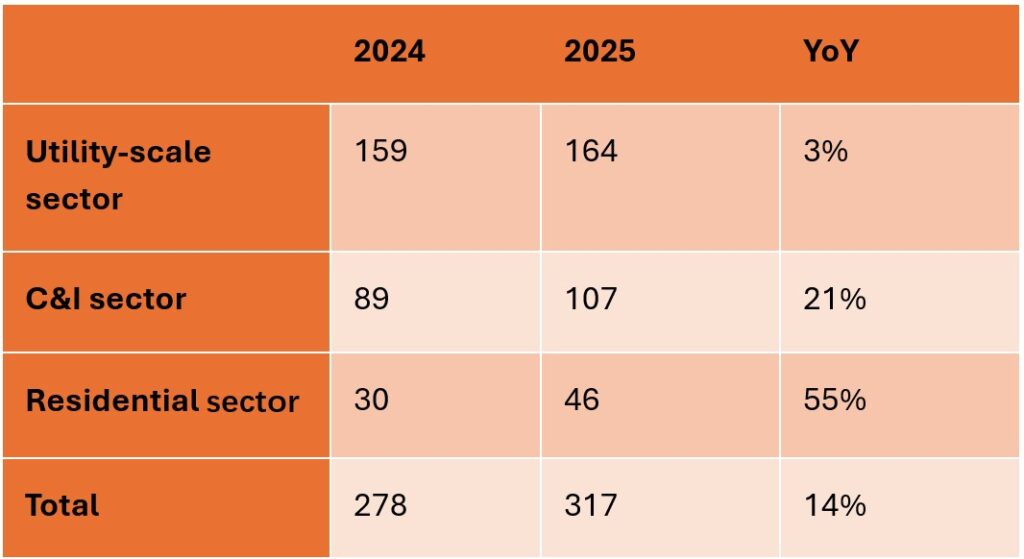
In 2025 alone, China PV added 317 GWac, with a year-on-year increase of 14%, hitting another record high, and amongst which:
- Utility-scale sector installations were 164 GWac, accounting for 52% of the total incremental installation, with a year-on-year increase of 3%.
- The C&I sector installed 107 GWac, accounting for 34%, with a year-on-year increase of 21%.
- The residential sector installed 46 GWac, accounting for 14%, with a year-on-year increase of 55%, due to the regulation and policy change.
With the increased PV penetration ratio, more synergies with other industries are required for a more sustainable development of the Chinese PV industry. By the end of 2025, the national installed capacity of new energy storage that was completed and put into operation reached 136 GW / 351 GWh[1], a more than 40-fold increase compared to the end of the 13th Five-Year Plan period, achieving leapfrog development. The average energy storage duration is 2.58 hours, which represents an increase of 0.30 hours compared with the end of 2024.
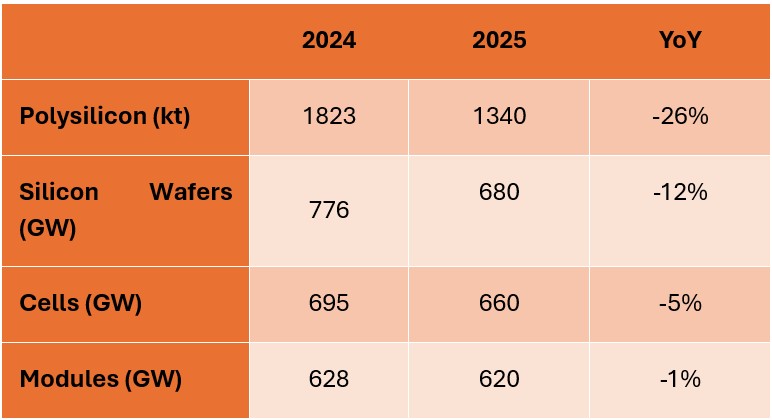
From supply side, according to CPIA (China Photovoltaic Industry Association), in 2025, the total polysilicon output reached 1.3 million tons, Wafer output reached 680 GW, Cell 660 GW, and module 620 GW, presenting a declined utilization rate.
Looking ahead to 2026, China’s PV market is expected to enter a phase of high-quality growth, with a focus on grid integration, storage synergy, and international cooperation under the framework of the Belt and Green Initiative.
Participants from China
Institute of Electrical Engineering, Chinese Academy of Sciences (CAS)
Institute of Electrical Engineering, Chinese Academy of Sciences (CAS), PV Committee of China Green Supply Chain Alliance (ECOPV)
Fang LYU
Vice Chair Asia-Pacific
Task - 1
Institute of Electrical Engineering, Chinese Academy of Sciences (CAS), PV Committee of China Green Supply Chain Alliance (ECOPV)
Fang LYU
Vice Chair Asia-Pacific
LONGI Green Energy Technology Co., Ltd.
PAN Wei
PV Committee of China Green Supply Chain Alliance (ECOPV)
DAI Jinhong
Task - 12
Institute of Electrical Engineering, Chinese Academy of Sciences (CAS), PV Committee of China Green Supply Chain Alliance (ECOPV)
Fang LYU
Vice Chair Asia-Pacific
PV Committee of China Green Supply Chain Alliance (ECOPV)
XU Junyu
Zhejiang Jinko Solar Co. Ltd.
DUAN Weiyuan
Pengfei ZANG
Task - 13
Institute of Electrical Engineering, Chinese Academy of Sciences (CAS)
Liu HAITAO
Task - 15
GoodWe
Junao (Jacob) ZHOU
LONGI Green Energy Technology Co., Ltd.
Song ZHANG
Task - 16
Public Meteorological Service Center (CMA)
Yanbo SHEN
Task - 17
Energy Internet Research Institute, Tshinghua University
LIU Yi
Task - 18
China Epower Solutions Corp. Ltd.
Nan YUAN
Yue LI
Institute of Electrical Engineering, Chinese Academy of Sciences (CAS)
SHAO Guiping
Task - 20
Institute of Electrical Engineering, Chinese Academy of Sciences (CAS)
Jindong GUO
Sungrow Renewables Development Co., Ltd.
An WEI
Xi’an LONGi Hydrogen Energy Technology Co.
Le JIAO
Task - 19
China Electric Power Research Institute
ZHANG Mingyuan
Institute of Electrical Engineering, Chinese Academy of Sciences (CAS)
E. Chunliang
Siemens Energy Co., Ltd.
YANG Zilong
Sungrow Renewables Development Co., Ltd.