2025 Update
PV Policy
The Commission has continued promoting the deployment of solar energy.
To follow up to the EU Solar Energy Strategy and the Action Plan for Affordable Energy, the Commission adopted in July 2025 a Recommendation and guidance for Member States to promote the development of innovative technologies and forms of renewable energy deployment, such as Agrisolar, Floating solar or Building-Integrated solar.
To facilitate the implementation of the solar mandate, which was introduced in the Energy Performance of Buildings Directive, a guidance was published in June 2025.
With the European Grids Package, published in December 2025, the Commission aims to build a modern, integrated, EU-wide grid network that can accommodate the growth of renewables and complete the internal energy market, ensuring a more affordable and secure EU energy system. As part of this package, the Commission has also put forward legislative proposals to streamline and shorten permitting procedures for small-scale solar PV installations and energy storage.
To strengthen manufacturing of PV and other net-zero technologies, the Net-Zero Industry Act (NZIA) is a key policy. It aims to a secure and sustainable supply of net-zero technologies through scaling up their manufacturing capacity in Europe. And sets as benchmark the manufacturing of at least 40% of the Union’s annual deployment. In 2025, the Commission put forward a number of secondary legislations to further support the implementation of the NZIA, including the following: a Delegated act on primarily used components under the Net-Zero Industry Act; an Implementing Act on non-price criteria in renewable energy auctions; an Implementing Act on main specific components relevant for the NZIA ‘Access to markets’ chapter and a Communication on shares of Union supply; and an Implementing Act for guidelines on strategic projects.
Research, Development and Demonstration
2025 saw the launch of the European Partnership of Innovation in Photovoltaics (EUPI-PV) under Horizon Europe.
This co-programmed partnership builds on the organisation of the European Technology and Innovation Platform on PV (ETIP-PV) and the different associations that structure the PV R&I landscape (SolarPower Europe, EERA-PV JP, ESMC, EUREC, PVthin), to better align European support for PV innovation with the priorities of the sector and increase the involvement of the PV industry in the research and innovation process.
The EUPI-PV aims to accelerate solar PV research and innovation by coordinating efforts across industries, universities and research centres, supporting the resilience and competitiveness of the European PV value chain, and fostering leadership in PV innovation. Key objectives include improved R&I collaboration, development of breakthrough PV technologies, and scaling up next-generation solutions to meet European energy transition and policy targets.
The first EUPI-PV topics were included into the Horizon Europe 2025 Work Programme (Cluster 5: Climate, Energy, and Mobility). Their focus was on:
1. Advanced Manufacturing and Technology Development:
- Optimised/Alternative Silicon Growth Technologies: Focused on silicon growth from liquid or gaseous phases to improve efficiency and reduce costs in PV applications. The total indicative budget for the topic was EUR 18 million.
- Perovskite PV Commercialization: Towards commercialization of Perovskite PV and development of dedicated manufacturing equipment. The total indicative budget for the topic was EUR 24 million.
2. System Integration and Flexibility:
- Novel Inverter Technologies: Developing smart inverters with high power density, using wide-bandgap materials (GaN, SiC) to supply synthetic inertia and grid services. The total indicative budget for the topic was EUR 18 million.
Industry and Market Development
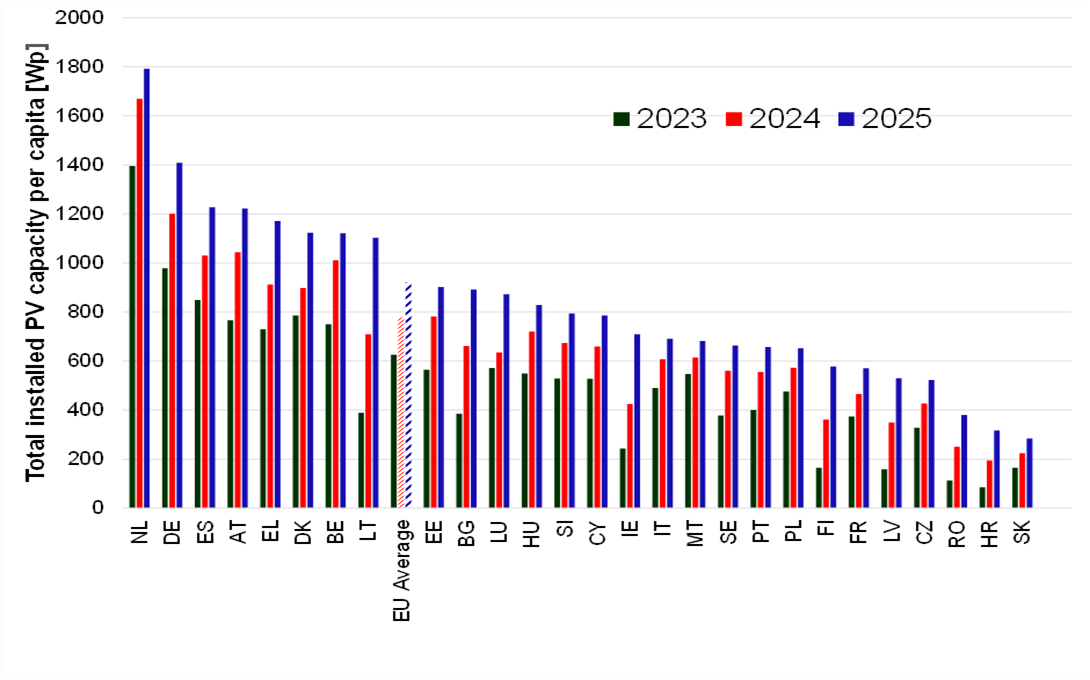
In terms of deployment, preliminary data show an annual installed capacity of around 65 GWDC, which is slightly lower than the capacity installed in 2024.
This slowdown is linked to several factors, including the declining impact of the energy crisis that had previously accelerated the deployment of rooftop PV, and the phase-out of net metering support schemes in several EU markets. The total cumulative installed capacity surpassed the 400 GWDC, exceeding the 2025 EU Solar Energy Strategy target of 320 GWAC, which is equivalent to approximately 380 GWDC. Even with this lower growth rate the EU Solar Energy Strategy’s target of achieving a nominal capacity of over 720 GWDC (600GWAC) by 2030 should be met.
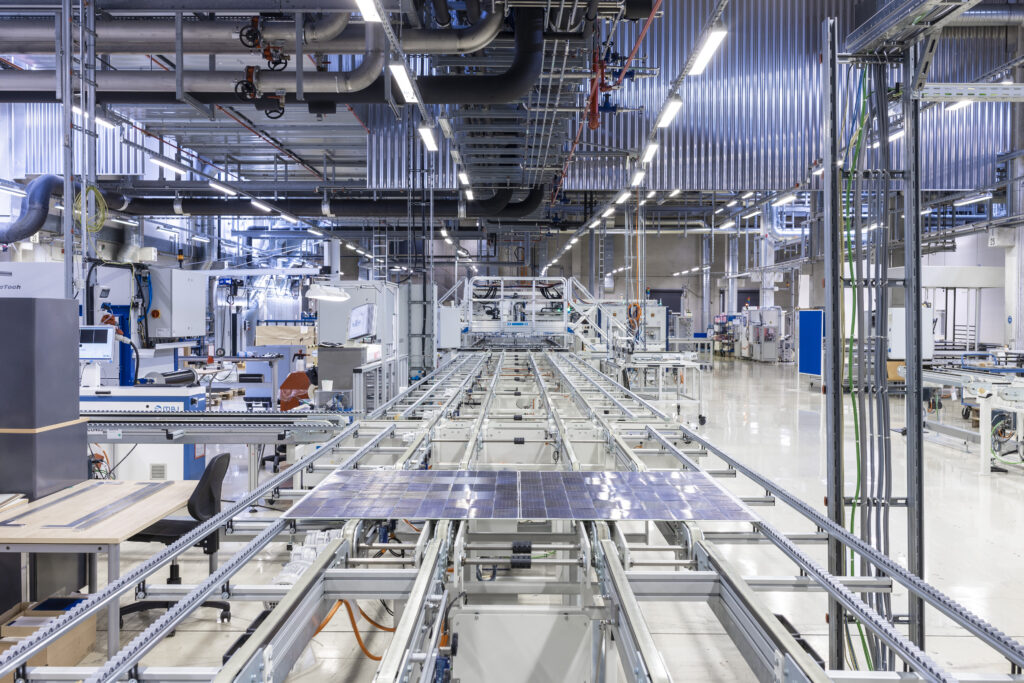
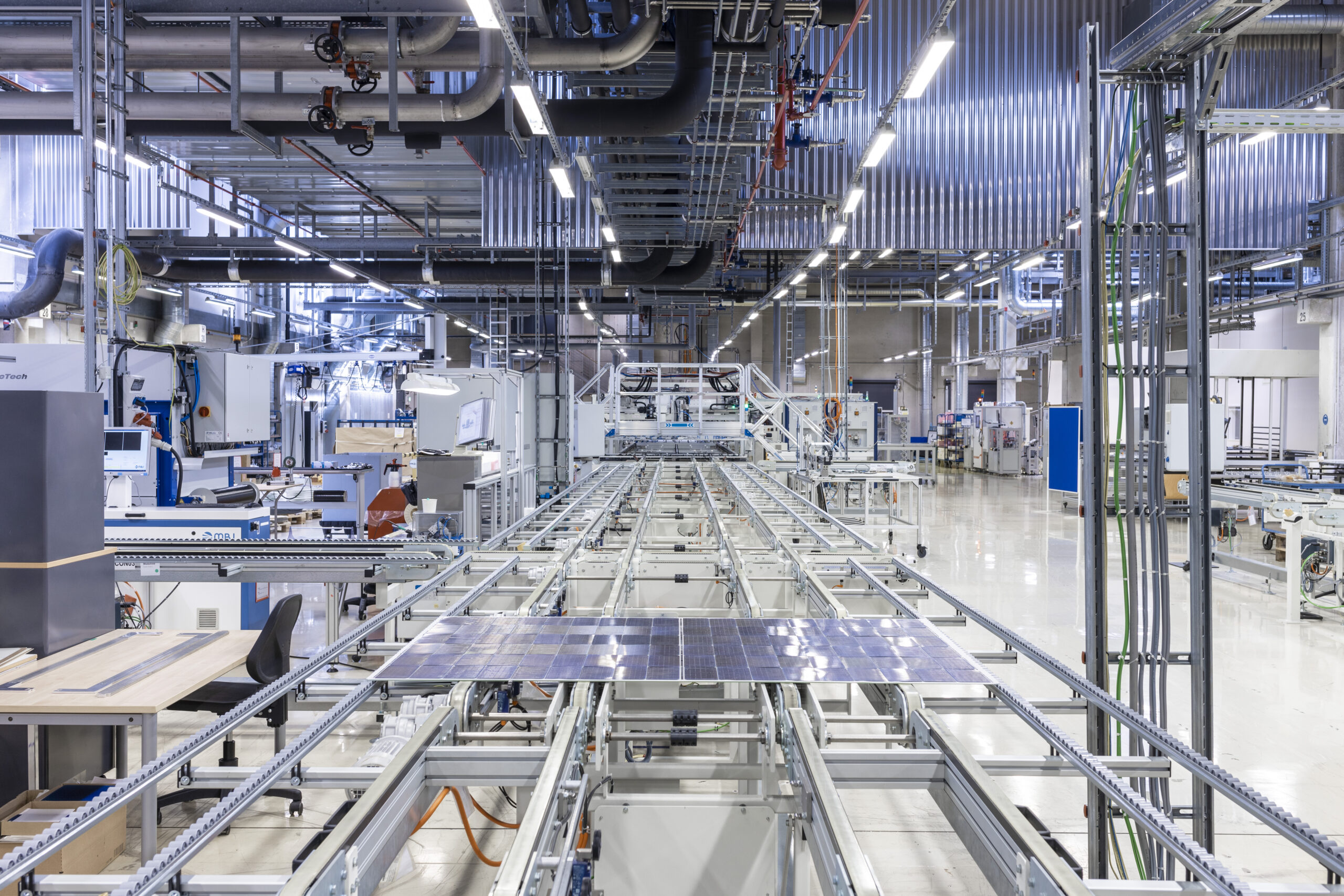
In terms of manufacturing, due to persistent low prices for PV modules, European PV manufacturers face challenging times. The EU manufacturing capacity in the solar PV value chain amounts to approximately 12 GWDC of PV modules, around 2 GWDC of PV cells, 25 GWDC of polysilicon, and less than 1 GWDC of PV ingots and wafers. Inverter manufacturing is still quite strong in the EU (over 121 GWAC ) but there is similar worrying pressures and trends as for the rest of the supply chain.
A key reason for the relatively low EU PV manufacturing capacity are the higher manufacturing costs for producing a PV module. The study “Reshoring Solar Module Manufacturing to Europe”, commissioned by SolarPower Europe and conducted by Fraunhofer ISE, quantifies the cost gap and lays out the policy levers needed for reshoring solar module module manufacturing in line with the EU Net- Zero Industry Act (NZIA) ambitions for 2030.
A key priority for the European Union is to scale up innovative solutions. To do so, it employs the Innovation Fund, the EU fund for climate policy, with a focus on energy and industry. The Innovation Fund aims to bring to the market solutions to decarbonise European industry and support its transition to climate neutrality while fostering its competitiveness. From its 2024 call for NetZero Technologies (IF24 Call), 3 projects resulted in support of PV technologies; 2 projects in support of PV manufacturing and the third one in support of Floating PV deployment, all launched in 2025.
- FENICE: FuturaSun advancEd italiaN manufacturIng Centre. The project aims to establish a new photovoltaic (PV) module production factory in Italy, specialising in n-Type and xBC (Back Contact) technologies developed in-house. The factory will produce up to 7.6 GWp of high-efficiency PV modules during its first ten years of operation. The project receives EUR 21 380 500 in EU cont
- MOD4PV: Gigawatt scale assembly plant of disruptive technology PV modules. MOD4PV aims to set new solar photovoltaic (PV) module production standards with an innovative PV module assembly plant in Extremadura, Spain. Targeting an annual production capacity of over 1.5 GWp, the project will rely on advanced heterojunction technology (HJT), which features higher efficiencies and energy yields than conventional PV technologies. The project receives EUR 87 774 046 in EU contribution.
- Floating Sky: FUSIO demonstrator: The project introduces a breakthrough Floating PhotoVoltaic (FPV) solution called FUSIO®, which aims to reduce the current costs of FPV solutions. Following its demonstration with a 100-kilowatt (kW) pilot, Floating Sky will launch its first large-scale FPV production facility of 12.2MWp in Belgium. The project receives EUR 3 200 000 in EU contribution.
Participants
European Commission Directorate-General for Research & Innovation
Task - 1
Task - 16
Joint Research Centre - European Commission