2025 Country Update
National PV Policy
Germany’s energy transition is reshaping the country’s energy supply to make it secure, clean, and affordable.
The Federal Government is moving away especially from fossil fuels and accelerating the shift toward renewable energy and greater energy efficiency. Germany has already made major progress; e.g. renewable energies account for approximately 59.0% of total net electricity generation in Germany in 2025 [Pie Charts Electricity Generation | Energy-Charts].
A key goal is to make the transition a driver of innovation, modernisation, and digitalisation across electricity and heat, as well as in transport, agriculture, and industry—while maintaining international competitiveness.
In Germany, the switch to renewable energies is being driven forward, with photovoltaics (PV) playing a central role. New legislation encourages tenant participation through landlord-to-tenant solar electricity models. Since December 2025, product standard DIN VDE V 0126-95 (VDE V 0126-95:2025-12) has applied to the connection of balcony power plants. For the first time, it regulates the safety requirements for grid-connected balcony power plants.
The simplified commissioning of balcony solar power plants has led to 433 000 new installations in 2025. Currently around 1,24 Mio. of them are already in operation. This high number shows that PV has reached the centre of society and enjoys a high level of social acceptance.
Finally, the transition depends heavily on expanding and modernising electricity grids. Because renewable generation is increasingly decentralised—and wind power is often produced in the north but needed in the south—Germany is working to strengthen transmission and distribution networks. Smart grids and smart meters are seen as essential tools to balance supply and demand and improve efficiency through digital management of the energy system.
By 2045, the German electricity supply should be almost climate-neutral, i.e. nearly completely powered by renewable energies and green hydrogen. The German government has therefore decided to increase the share of renewable energies in Germany’s (gross) electricity consumption to over 80% in 2030. To this end, the Renewable Energy Sources Act (EEG) provides for 215 gigawatts of installed photovoltaic (PV) capacity in 2030. This requires an annual increase of 19.5 GW in the coming five years. With a slight decline in new capacity compared to the previous year, the current status indicates that the increase in 2025 will be 16.9 GW. Just under half of the added capacity was accounted for by rooftop solar systems, with the rest coming from ground-mounted photovoltaic systems. In the previous year, rooftop solar systems accounted for twice as much capacity as ground-mounted solar systems. The total installed solar capacity reached 117,5 GW as shown in Figure 3.
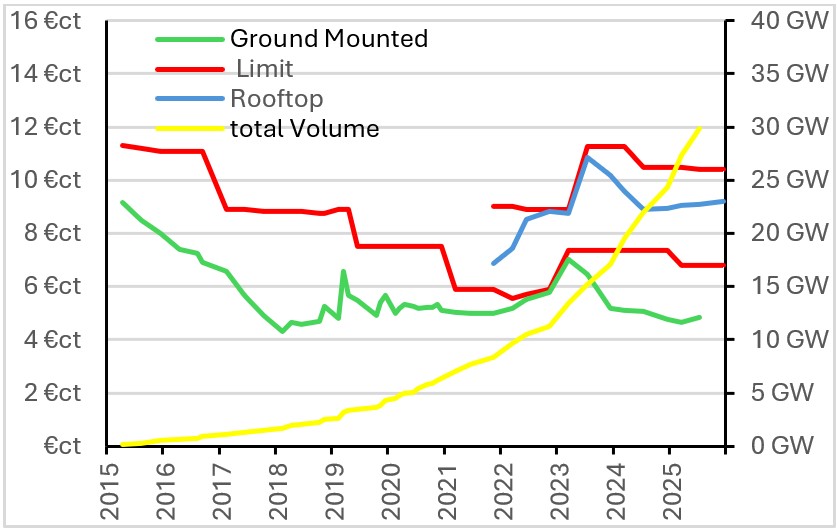
So, Germany is still on the way to achieving its solar goals. This is also reflected in the consistently high participation in the Federal Network Agency’s tendering rounds for ground-mounted PV systems. The total tender volume in 2025 was 8.8 GW for ground-mounted, rooftop, and innovation systems together. The development of surcharge values over recent years is shown in Figure 2.
This strong expansion is sensible and necessary, as photovoltaics is one of the cheapest sources of energy and therefore one of the most important sources of electricity generation in the future.

Research, Development and Demonstration
For many years, industry-related applied energy research is supported by specific funding programs
The funding announcement for the most recent 8th Energy Research Program for applied energy research entitled ‘Research contracts for the energy transition’ has been in force since April 2024. It sets out the objectives and priorities for research funding in the coming years. For the first time, the BMWE is pursuing a mission-oriented research and innovation policy. The focus is on cross-sector and cross-thematic project funding that is targeted at specific and ambitious goals. In this way, research results should contribute to accelerating the transformation of the energy system and be put into practice quickly.
The five missions of the BMWE’s energy research program are
– Mission Energy System 2045: Research for a resilient and efficient energy system
– Mission heat transition 2045: Research for a climate-neutral heating and cooling supply
– Mission electricity transition 2045: Research for the conversion of the electricity supply to renewable energies
– Hydrogen mission 2030: research for a sustainable hydrogen economy
– Mission Transfer: rapid transfer of research results into practice
PV is an important part of the Mission Electricity. The main focal points for photovoltaics research in 2025 were again topics relating to technology developments for highly efficient solar cells and modules, silicon-perovskite tandem solar cells, and issues of reliability and sustainable operation of photovoltaic systems. A secondary topic deals with the integration of PV systems in both, the built environment and the energy system.
The Federal Energy Research Report provides an overview of the strategic direction, progress and successes of energy research in Germany. This report contains information and figures on current research and development projects being funded in the energy sector, particularly in the field of photovoltaics.
Industry and Market Development
In 2025, Germany’s photovoltaic industry experienced a strong expansion in installations while domestic manufacturing remained under significant pressure.
Although solar capacity additions continued at a high pace and photovoltaic power generation increased markedly, the industrial side of the sector faced considerable challenges. This situation is somewhat paradoxical: record levels of solar expansion coinciding with weak or largely absent large-scale manufacturing within the country. Overall, 2025 can be characterised as a year of continued robust PV growth and rising solar electricity output in Germany. For the first time, electricity generation from photovoltaics ranks second as a source of electricity generation, overtaking lignite as a source. The share of renewable energies based on gross electricity generation is 57.3 per cent. Photovoltaic systems contributed 89.5 billion kWh to this total. However, this year has also seen a significant slowdown in the private rooftop system segment and ongoing structural challenges for the domestic PV manufacturing industry.
The number of people employed in the German photovoltaic industry has risen significantly in 2025, with estimates suggesting over 100 000 jobs. This growth is primarily driven by the massive expansion of installed capacity.
Participants
Task - 1
Task - 12
Fraunhofer Institute for Solar Energy Systems (ISE)
Sebastian NOLD
Task - 13
Fraunhofer Center for Silicon Photovoltaics CSP
David DAßLER
Ralph GOTTSCHALG
Fraunhofer Institute for Solar Energy Systems (ISE)
Christian SCHILL
Ingrid HÄDRICH
Karl-Anders WEISS
Institute for Solar Energy Research GmbH (ISFH)
Marc KÖNTGES
TÜV Rheinland Solar GmbH
Magnus HERZ
Univers GmbH
Sascha LINDIG
Task - 16
CSP Services
Anne FORSTINGER
Fraunhofer Institute for Solar Energy Systems (ISE)
Elke LORENZ
German Aerospace Center (DLR)
Stefan WILBERT
Task - 17
Forschungszentrum Jülich GmbH
Kaining DING
Task - 18
Africa GreenTec
Felix GRETHLEIN
PETERS Fabian
Asantys
Jad MHANNA
Stefan TRITTLER
Ecolog Institute
Reema SINGH
Tobias KLAUS
Fraunhofer Institute for Solar Energy Systems (ISE)
Felix STORTZ
Georg BOPP
OFRES
Reiner Lemoine Institute
Philipp BLECHINGER
Rolls Royce Solutions
Nicolas GEZE
Simon ROSENFELD
Task - 19
Energynautics GmbH
Thomas ACKERMANN
Fraunhofer IEE
Denis MENDE
Technische Hochschule Ulm (THU)