2025 Country Update
PV Policy Programme
The foundation for renewable energy development in Lithuania was the National Energy Independence Strategy adopted by the Parliament (Seimas) in 2019.
The strategy established the following targets:
a) to eliminate dependence on Russian electricity imports by 2023;
b) to generate 45% of electricity from renewable sources by 2030; and
c) to produce 80% energy from renewable sources—including electricity, heating, and transport—by 2050.
The rapid development of renewable energy in the country called for a more ambitious plan, and a new version of National Energy Independence Strategy was adopted in 2024, bringing forward the 100% renewable electricity target even to the year 2030. It means that all electricity will be produced locally and represents a dramatic transformation compared to 2015, when approximately 80% of Lithuania’s electricity was imported almost entirely from Russia.
A major milestone in Lithuania’s energy transition was reached in 2025, when Lithuania, together with Latvia and Estonia, withdrew from the BRELL (Belarus–Russia–Estonia–Latvia–Lithuania) electricity ring. The Baltic grids were synchronized with the Continental European network, ensuring full technical and political independence from the Russian system.
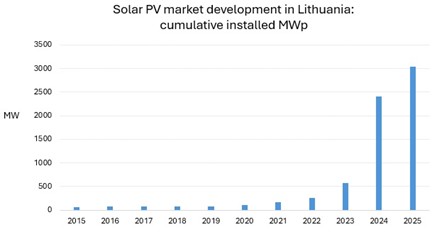
Solar PV has played a key role in this transformation. From virtually zero capacity in 2010 and only 90 MW in 2020, rapid development over the past five years increased installed capacity to 3 040 MW in 2025. This corresponds to 1 053 kW per capita, placing Lithuania among the EU leaders in photovoltaic deployment.
In 2025, solar power plants generated 1.79 TWh of electricity, accounting for 14.2% of total national electricity consumption. Together with wind farms —producing 4.29 TWh from 2.47 GW of installed capacity—, renewable sources covered 68.1% of Lithuania’s domestic electricity demand.
The main driver for this rapid development has been a consistent and forward-looking state policy implemented by the Ministry of Energy. Between 2015 and 2022, the most effective instrument for PV expansion was the introduction and expansion of a net-metering scheme supporting the growth of “prosumers.”
The net-metering scheme introduced in Lithuania has high flexibility, as there were no capacity limits for households or companies. Consumers were allowed to purchase a share of a solar park located anywhere in the country and use the generated electricity at their place(s) of consumption. A user-friendly IT platform enabled efficient accounting, while providing option to settle grid service charges by part of the electricity generated.
This attractive support scheme led to the emergence of 170 000 prosumers by 2025, representing approximately 9% of all electricity consumers. Prosumers accounted for around 70% of total solar electricity production in 2025. The net-metering system also enabled efficient use of solar electricity for heating through heat pumps, significantly increasing the popularity of green heat and hot water production in both single-family and multifamily buildings.
Recently, modifications to the support were introduced for commercial companies, which are now required to transit to a net-billing system, while net-metering systems can still be applied to households and non-profit entities. All new solar producers are expected to operate under net-billing arrangements in the near future.
Another important driver of PV development has been a well-designed public investment support scheme, which typically covers up to 30% of installation costs. This support has been available to households and small and medium-sized enterprises, but not to utility-scale solar parks. Large-scale projects generally do not require subsidies due to the significant decline in PV module costs in recent years.
The main source of financial support has been the Climate Change Programme, funded through revenues received by Lithuania under the EU Emissions Trading System (EU ETS).
In 2025, the main obstacle to further PV expansion was grid connection capacity. The rapid growth of both solar and wind installations exceeds the absorption capacity of distribution and transmission grids. As a result, battery energy storage systems (BESS) have become a key driver for further growth of the renewable energy generation.
In 2025, technical permits were issued for the development of BESS facilities with a combined capacity of nearly 2 GW. This is expected to significantly improve grid flexibility in the near future. The Kruonis Pumped Storage Power Plant with 900 MW operating in Lithuania make a significant contribution to balancing the fluctuations of solar and wind power. To increase generation flexibility, it is currently being reconstructed to a capacity of 1 050 MW. This will significantly expand the grid’s capability to integrate electricity generated by renewable energy sources.
Additional mitigation is provided by allowing solar and wind installations to share the same grid connection point. This newly introduced option was based on studies showing that in Lithuania’s climatic conditions, solar PV generation peaks during summer and daytime hours, while wind generation is stronger in winter and at night. Such hybrid power plants make it possible to connect capacities that exceed the nominal technical limits of the grid, effectively increasing grid utilization and partially resolving competition between solar and wind projects.
The geopolitical situation in Europe, particularly the war in Ukraine, has significantly increased the importance of cybersecurity in the energy sector. Many inverters used in solar installations are manufactured outside the EU, primarily in China. PV operators in Lithuania are actively implementing government recommendations and seeking technical solutions to reduce dependence on external control systems.
Research, Development and Demonstration
Two decades ago, Lithuania took steps to accelerate solar energy development by establishing local manufacturing of PV cells and modules.
Several modern factories with a combined capacity of approximately 200 MW were deployed. However, like in other EU countries, these manufacturers faced strong competitive pressure from Chinese imports and were forced to adapt or change their business models.
Subsequently, several R&D institutions and companies formed a photovoltaic technology cluster focused on innovative solutions, particularly building-integrated photovoltaics (BIPV). Currently, three manufacturers produce customized PV products, including solar roofing replacements, PV tiles, metal-roof-integrated modules with matte surfaces, coloured modules, and PV elements integrated into roadside barriers.
Collaboration between researchers, developers, and manufacturers in Lithuania is strong, and exports of these specialized products are increasing annually.
A major new area of expansion is the integration of PV systems with heat pumps. Public institutions responsible for the refurbishment and energy modernization of Soviet-era multifamily buildings have recognized the potential of this combination. Several Horizon 2020 projects enabled the establishment of demonstration sites where rooftop PV systems power heat pumps. These projects clearly demonstrated the economic and environmental benefits of such systems for apartment owners, and the initiative is now expanding rapidly across the country.
The next stage of the development involves integration not only BESS but also thermal energy storage. Advanced heat storage systems using phase-change materials in combination with heat pumps have begun to be deployed, initially in households. R&D institutions are also contributing to the further enhancement of energy management systems, which are becoming increasingly important as PV systems, heat pumps, electrical storage, and thermal storage are integrated. Some Lithuanian companies have already achieved promising results in this area.
BESS research in Lithuania is primarily focused on sodium-based storage solutions, as they are safer and perform better under outdoor conditions in the cold climate.
Industry and Market Development
PV installations have experienced extremely rapid growth in recent years. From 26 MW in 2022, installed capacity increased to 3 040 MW in 2025.
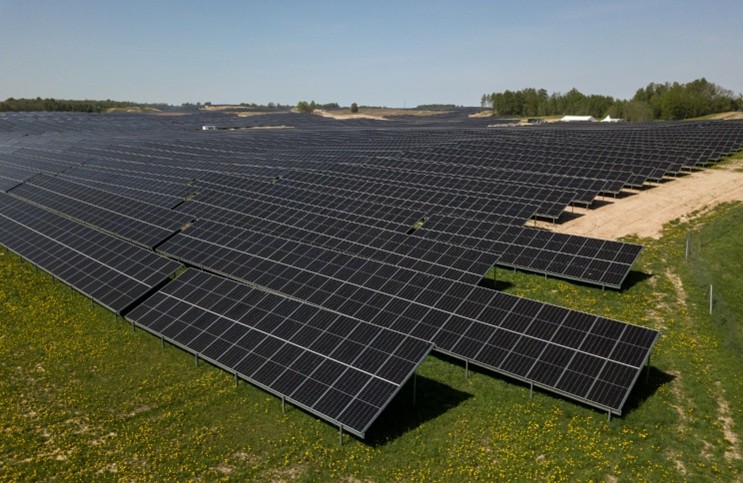
The largest solar park in Lithuania, with a capacity of 100 MW, was commissioned in 2025, and several similar projects are scheduled to begin operation in the coming year.
Growth is expected to continue, as technical permits have already been issued for an additional 4 GW of solar capacity. However, grid connection availability remains the primary constraint.
The state-owned transmission system operator, Litgrid, has prepared a comprehensive grid development programme supported by both its own financial resources and EU funding. The Lithuanian Solar Energy and Storage Association works closely with the Ministry of Energy and grid operators to propose balanced technical and regulatory solutions.
With continued grid reinforcement and storage deployment, PV developers expect a return to accelerated growth in the coming years.