2025 Country Update
National PV Policy
Morocco has set a strategic national objective to achieve 52% of installed electricity capacity from renewable energy sources by 2030, as part of its long-term energy transition strategy.
To accompany this vision, Decree No. 2.25.100 established the regulatory framework governing the construction and operation of electricity self-generation installations under law No. 82-21. It introduces a differentiated approach based on the size and grid connection level of the installations, defining specific procedures ranging from a simple declaration regime for small off-grid systems to connection approval and formal authorization requirements for medium- and high-voltage grid-connected projects. This framework provides greater regulatory clarity for investors and supports the development of decentralized renewable energy and self-consumption in Morocco.
For self-consumption applications and in coherence with the provisions of Article 5 of Law No. 13-09 on renewable energy, as amended and supplemented by Law No; 40-19, and Article 23 of Law No. 82-21 on electricity self-generation, the National Electricity Regulatory Authority (ANRE) approved the hosting capacity of the electricity system for 2025 at a solar hosting capacity of 2 798 MW in the 2025 communication and the solar hosting capacity projected for 2026 was 2 900 MW. However, in the new 2026 communication the declared capacity is 2 709 MW.
For what is the renewable capacity progress that has been made throughout the year, by mid-2025 Morocco had already reached 45.5% renewable installed capacity, indicating strong progress and making clear that the 52% target could be achieved as early as 2028. This capacity currently comprises conventional hydropower (44.6%), wind (23.8%), solar (16.9%) and pumped storage (14.8%). This progress is supported by the next generation solar projects, notably Noor Midelt II and Noor Midelt III, each with a capacity of 400 MW. These plants are designed as hybrid projects combining solar generation with battery energy storage systems (BESS). Each facility will be co-located with a 602 MWh battery storage system, significantly enhancing grid flexibility and enabling higher penetration of variable renewable energy. These developments reflect Morocco’s evolving energy policy increasingly focused on PV combined with storage in line with national goals of long-term energy security and cost efficiency.
According to the National Electricity Regulatory Authority (ANRE), the country deployed approximately 204 MWp of new utility-scale solar capacity throughout the year. In addition, more than 1GW of capacity was added across the commercial and industrial (C&I), solar pumping and residential segments, based on import data from Moroccan customs. However, the distributed segments remain difficult to track accurately due to limited official reporting and reliance on import statistics. The cumulative installed capacity stands at approximately 1 285 MWp of utility-scale solar PV and 534 MWe of concentrated solar power (CSP), according to data from the National Office of Electricity and Drinking Water (ONEE). And beyond the utility-scale, the C&I, solar pumping and residential segments are estimated to account for more than 3 GWp of additional installed capacity. These figures are largely derived from equipment import data especially from China.
In parallel, Morocco is diversifying its solar portfolio through innovative technologies including the development of a 13 MW floating photovoltaic plant. This project reflects a forward-looking policy approach that optimizes land use, reduces water evaporation from reservoirs and contributes to distributed generation strategies. The integration of floating PV further demonstrates Morocco’s commitment to technological diversification and resources efficiency within its broader decarbonization roadmap.
For what is industrial-scale deployment, OCP Green Energy is adopting remarkable accelerating actions by commissioning the first phase of its solar program with 202 MWp, reported as the largest PV plant currently in operation in Morocco—within OCP Group’s broader ambition to supply its industrial operations with ~5 GW of clean energy by 2027.
Looking at the 2030 vision, we identify the 2025-2030 Electric Equipment Plan which clearly translates Morocco’s long-term energy transition objectives into concrete investment priorities. With a total planned additional capacity of 12 445 MW, of which nearly 80% will be renewable, the plan confirms that decarbonization remains the structural backbone of national power sector policy. Solar alone represents the largest share of new additions (35.8%), reflecting a strategic pivot toward PV driven capacity growth, increasingly combined with storage solutions. Wind power continues its expansion (31.8%), consolidating Morocco’s position as a regional leader in wind deployment.
At the same time, the inclusion of 1 500 MW of battery energy storage systems (BESS) signals a major policy evolution: the focus is no longer solely on adding renewable capacity, but on ensuring system flexibility, dispatchability, and grid resilience. The 20.6% allocation to gas turbines further illustrates a pragmatic transition strategy, providing fast-reacting backup capacity to secure while enabling higher penetration of variable renewables.
Overall, the plan demonstrates a balanced and forward-looking policy framework dependency, and positions Morocco on the path to exceed its 2030 renewable target ahead of schedule.
As for rooftop applications, the SR500 (Solar Rooftop 500) project has been recently introduced to accelerate the deployment of distributed solar photovoltaic systems. The initiative aims to install up to 500 MW of rooftop solar capacity, primarily across commercial, industrial and public sector buildings. By promoting decentralized generation, SR500 will increase solar penetration in the energy mix, reduce pressure on the grid and contribute to a more resilient and sustainable electricity system.
Research, Development and Demonstration
Morocco continues to strengthen its position in PV R&D and demonstration in line with the national objectives with current R&D priorities spanning PV grid integration and advanced control, technology adaptation to harsh climates (high-performance and bifacial module performance, soiling/thermal mitigation, optimized cleaning/cooling), storage and hybridization (PV+BESS, hydrogen-based and hybrid solutions), and diversified PV applications (Floating PV, Agri-PV, and Power-to-X).
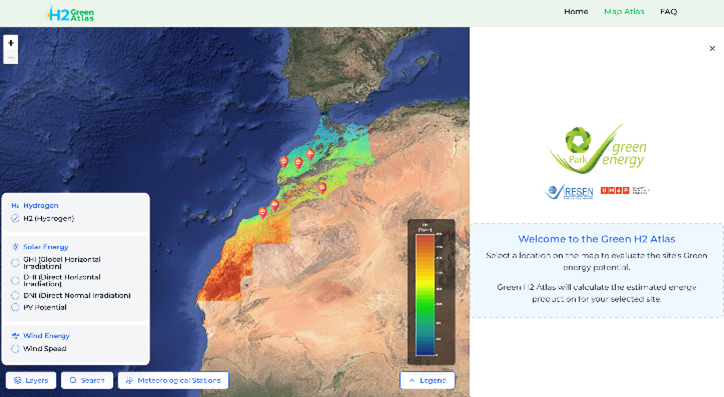
Complementing OCP’s large-scale renewable deployments, GEP researchers are advancing (i) Digital Twin O&M tools to support performance monitoring, predictive maintenance, and operational optimization for the 105 MW flagship plant, and (ii) a new decision-support platform for large industrial sites that co-optimizes process operations, material-flow dynamics, storage, and renewable assets across multiple time horizons to quantify flexibility value (buffering, sizing, smart scheduling), maximize renewable utilization, and reduce curtailment and emissions. In addition, R&D efforts increasingly focus on modeling and evaluating PV (and hybrid renewable) potential for emerging green hydrogen projects, leveraging geo-spatial and techno-economic screening approaches illustrated by Morocco’s Green H2 Atlas initiative that maps and analyzes green hydrogen, potential hybrid solar inclusion, and wind potential to support project development and bankability. (greenh2atlas.ma)
Always within the research framework, and in response to the lack of tracking tools for on-grid and off-grid PV installations, IRESEN is currently developing a PV detection tool which leverages geospatial analysis and GIS (Geographic Information System) technologies. The tool is being designed not only to identify PV installations but also to classify them by building type and integrated them into a comprehensive geospatial map layer, aggregating all relevant information through trained detection models.
Industry and Market Development
In the context of PV industry development, Solaris Tangier, the strategic local producer of half-cell panels, based in the Tangier Free Zone, has a production capacity of 700 MW and is primarily export-oriented.
The company focuses on international markets because the current regulatory framework in Morocco does not strongly encourage local production. Imported solar panels from China face relatively low duties of only 2.5%, making it difficult for locally manufactured products to compete and stand out in the domestic market. As a result, export markets — particularly in the Americas— represent a strategic outlet for Solaris Tanger. This contrasts with other countries, such as Tunisia, that actively support domestic manufacturing by imposing import duties of around 30% on foreign panels, creating a more favourable environment for local products.
At the market development level, large-scale utility projects remain the dominant driver of capacity additions. Recent large-scale solar power plant installations illustrate the growing dynamism of private-led development. These projects reflect remarkable progress in technical expertise and the successful implementation of high-capacity installations, demonstrating increasing investor confidence and the continued maturation of the market. In this context, the structure of the distributed market provides additional insight into sector dynamics, according to a solar market assessment study conducted in 2024, solar pumping represents around 60% of the distributed market, C&I account for approximately 30% and residential systems make up about 10%. Utility-scale projects are not included in this breakdown as their annual contribution varies significantly depending on tender schedules and project commissioning timelines. In addition, the main driver of Morocco’s solar market was falling technology costs and improving project bankability. Looking ahead, several key drivers are expected to further accelerate deployment such as ongoing regulatory maturation with new laws and decrees being approved, and rising electricity tariffs. Drivers are expected to further accelerate deployment such as ongoing regulatory maturation with new laws and decrees being approved, and rising electricity tariffs.
Participants
Task - 1
Task - 13
Green Energy Park
Ibtihal Ait ABDELMOULA
Task - 18
Task - 19
Green Energy Park