2025 Country Update
National PV Policy
Photovoltaic development in Portugal during 2025 continued to be framed by the revised National Energy and Climate Plan 2030 (NECP), which confirmed solar PV as the principal contributor to incremental renewable electricity capacity.
The target of 20.8 GW AC of installed solar capacity by 2030 implies a sustained acceleration of deployment over the second half of the decade.
By the end of 2025, total renewable installed capacity reached approximately 21.9 GW, of which solar PV represented 6.8 GW. Solar capacity increased by more than 1 GW during the year, maintaining its position as the fastest-growing renewable technology in the country. Since 2016, installed PV capacity has expanded from less than 1 GW to nearly 7 GW, illustrating the structural transformation of the electricity mix.
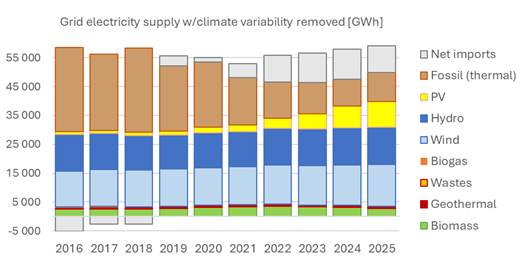
Electricity generation from renewable sources reached around 45 TWh in 2025, corresponding to approximately 75% of gross electricity production (see Fig. 1). Solar PV alone generated about 8.7 TWh, an increase of more than 20% compared to 2024. Solar PV now accounts for roughly one sixth of total electricity generation and close to one fifth of renewable generation.
As PV penetration increases, policy focus is progressively shifting from capacity expansion to system integration. Grid reinforcement measures foreseen in the national transmission and distribution development plans are advancing, although connection capacity remains regionally constrained, particularly in high-resource areas.
Limited curtailment episodes were recorded during 2025, amounting to approximately 14 hours at transmission level. While modest in quantitative terms, these events illustrate the gradual emergence of flexibility constraints during periods of high renewable output.
The large-scale system disturbance of 28 April 2025 did not originate in photovoltaic generation but contributed to renewed reflection on operational resilience in a system increasingly dominated by inverter-based resources. Discussions during the year addressed enhanced monitoring of distributed generation, advanced inverter functionalities and coordination between transmission and distribution operators.
Extreme weather events also underlined the importance of installation quality and structural compliance. During early 2026, storm Kristin brought extreme winds. This caused localised damage to some installations, reinforcing the relevance of wind-load standards, inspection regimes and installer certification.
In parallel, cybersecurity considerations gained increasing prominence as PV plants —particularly large-scale and hybrid facilities— rely extensively on digital monitoring and remote-control systems. Strengthening communication protocols and digital resilience is progressively becoming embedded in system planning.
As solar deployment accelerates, social acceptance and public perception are becoming increasingly relevant factors in project implementation. In some regions, large-scale photovoltaic developments have been subject to public scrutiny regarding land use, biodiversity protection and landscape integration. While environmental assessment procedures are well established within the Portuguese regulatory framework, public debate has at times been influenced by incomplete or inaccurate information circulating through digital platforms.
In response to these challenges, the renewable sector has strengthened its engagement with scientific institutions and civil society. A relevant example is the BioImpacte+ initiative, promoted by APREN in partnership with the environmental consultant BioInsight, which aims to assess and communicate the real biodiversity impacts of renewable energy projects based on empirical evidence. By combining field research, environmental monitoring and stakeholder dialogue, such initiatives contribute to improving transparency, countering misinformation and reinforcing evidence-based policy discussion.
Ensuring that local communities perceive tangible environmental and socio-economic benefits from photovoltaic projects will be decisive for maintaining deployment momentum towards the 2030 targets.
Research, Development and Demonstration
Photovoltaic research and innovation activities in Portugal continue to evolve from component-level investigation towards system integration, hybridisation and applied demonstration projects aligned with high renewable penetration scenarios.
Public support is largely channelled through European programmes, notably Horizon Europe, complemented by national Recovery and Resilience Plan (PRR) funding.
A representative-applied initiative is the FruitPV project, financed under the Portuguese Recovery and Resilience Plan. The project explores agrivoltaic configurations adapted to fruit orchards, assessing agricultural productivity alongside photovoltaic performance. Led by the Centro Operativo e Tecnológico Hortofrutícola Nacional (COTHN), in partnership with the National Institute for Agricultural and Veterinary Research (INIAV), Akuo and other stakeholders, FruitPV is testing structural designs and light-management strategies to optimise dual land use. Private R&D also exists, e.g. the Portuguese LuxOEnergy company, in partnership with SBFC Hightech, is running pilot projects of shading orchards with their flexible bifacial panels. Agrivoltaics more broadly is emerging as a growing research and demonstration field, particularly in southern Portugal. Pilot projects increasingly incorporate digital monitoring systems to assess microclimatic effects, crop yield impacts and energy output optimisation.
Portuguese universities and research centres remain active across the PV value chain. Institutions such as Instituto Superior Técnico (University of Lisbon) and the University of Porto conduct research on power electronics, inverter control strategies and grid integration under high shares of inverter-based generation. Participation in Horizon Europe consortia further supports work on hybrid PV-plus-storage optimisation, digital twins for predictive maintenance, flexibility services and cybersecurity for decentralised energy systems.
The increasing operational complexity of the electricity system has strengthened research interest in dynamic modelling and stability analysis. Collaboration between academia and system operators is expanding in order to simulate high-renewable dispatch conditions and evaluate resilience under stress scenarios.
Workforce capacity is emerging as a structural pillar of the energy transition. Sustained annual additions of solar capacity require expansion of qualified personnel in installation, electrical engineering, structural compliance, SCADA operation and hybrid plant management.
Universities, polytechnic institutes and vocational training centres are progressively updating curricula to include renewable integration, smart grids and digital energy systems. Industry associations are reinforcing certification frameworks and technical training programmes to safeguard installation quality and long-term asset reliability.
For the 2026–2030 period, alignment between research institutions, training bodies and industry will be essential to ensure that technological innovation translates into scalable and resilient deployment.
Industry and Market Development
Photovoltaic deployment remained strong in 2025. Total renewable installed capacity reached approximately 22 GW, with solar accounting for 6.8 GW. Solar continues to lead annual renewable capacity additions.
Solar generation reached approximately 8.7 TWh in 2025, confirming its position as the third-largest renewable source after hydro and wind. Regional distribution remains concentrated in the south, with the Alentejo accounting for more than one third of national solar output, followed by the Centro and Norte regions.
Distributed generation continued to expand steadily. Installed decentralised PV capacity surpassed 3 GW, with self-consumption units representing the majority share. Production from decentralised systems exceeded 3.7 TWh, reflecting the increasing participation of commercial and industrial consumers alongside residential installations.
Wholesale market dynamics during 2025 were characterised by continued intraday price volatility, particularly during hours of high solar production. Long-term Power Purchase Agreements remain the principal risk mitigation instrument for utility-scale projects, while hybridisation with battery storage is increasingly incorporated into plant design to mitigate price cannibalisation and enhance dispatchability.
Portugal’s photovoltaic industry remains predominantly service-oriented, with strong capabilities in project development, engineering, construction, operation and asset management. Although upstream manufacturing is limited, expertise in system integration, agrivoltaics, floating PV and digital optimisation tools is strengthening.
In the wake of less ambitious goals for renewable hydrogen by 2030, the NECP target of 20.8 GW solar capacity is probably going to be downsized in the near future. Even so, PV additions must rise to above 1.5 GW per year, which appears challenging given the current slow licensing pace and increasing social opposition. Also, grid reinforcement and digitalisation will be decisive in unlocking additional connection capacity. Battery storage deployment is expected to scale progressively to support flexibility and mitigate revenue volatility under high solar penetration scenarios. Market design evolution, including long-term contracting frameworks and flexibility remuneration mechanisms, will influence investment stability. As solar share increases, revenue structures are likely to diversify, combining merchant exposure, corporate PPAs and hybrid asset strategies.
If enabling conditions evolve coherently, solar PV is expected to become the dominant source of electricity generation in Portugal before the end of the decade, playing a central role in decarbonisation and energy security objectives.
Participants
Directorate-General for Energy and Geology (DGEG)
Task - 1
Directorate-General for Energy and Geology (DGEG)
Task - 16
University of Lisbon
Rodrigo AMARO E SILVA
Task - 17
University of Lisbon Instituto Dom Luiz (IDL)