2025 Country Update
National PV Policy
Spain’s Strategic Energy and Climate Framework outlines its pathway to achieving climate neutrality. The framework consists of four core initiatives, several of which were updated in 2025:
- Integrated National Energy and Climate Plan 2023-2030 (INECP): One of the most significant aspects of the updated 2024 plan is the pivotal role of photovoltaic technology in Spain’s energy transition. The strategy targets 76 GW of installed solar photovoltaic capacity including 19 GW of self-consumption capacity by 2030—double the original goal of 39 GW—alongside robust growth in energy storage, reaching 22.5 GW;
- Long-Term Decarbonisation Strategy 2050: This strategy is currently under review to align with the new targets and requirements outlined in the INECP. The Spanish Government launched a public consultation at the end of 2024, which concluded in January 2025, yet unpublished;
- Law 7/2021, of 20 May, on Climate Change and Energy Transition;
- Just Transition Strategy & National Strategy against Energy Poverty: A prior public consultation on the Just Transition Strategy 2026-2030 was launched on 1 December 2025 with the primary goal to capitalize on economic and employment opportunities from the shift to a low-emission economy, while mitigating the impact on workers and vulnerable regions.
Other relevant initiatives that also form part of the Energy Transition Strategy include the following and have been update in 2025:
- The Self-consumption Roadmap: the Government introduced a Royal Decree to modernize the regulatory framework for self-consumption. The updated National Integrated Energy and Climate Plan (2023–2030) raises the ambition for Spain’s energy transition, projecting 19 GW of self-consumption capacity by 2030.
- The Ministry for the Ecological Transition and the Demographic Challenge (MITECO) unveiled the 2025-2029 Mineral Raw Materials Action Plan, emphasizing recycling, sustainability, and strategic autonomy. The draft, released for public consultation in March 2025, marks the first action plan under the Roadmap for Sustainable Management of Raw Materials for the 2025–2029 period.
- Planning of the Electricity Transmission Network 2021-2026: In July 2025, a second round of modifications to the Electricity Transmission Network 2021–2026 Development Plan was approved, further enhancing the resilience of Spain’s electricity grid. This update represents the second amendment to the plan, following the initial revision in 2024. The new amendment introduced 65 targeted actions designed to strengthen the grid’s infrastructure.
Following the major blackout on 28 April 2025, Spain introduced new decrees and regulations addressing photovoltaic energy and electricity market reforms.
The Spanish Government enacted Royal Decree Law 7/2025 of 24 June 2025, introducing urgent measures to enhance the resilience and flexibility of Spain’s electricity system and modernize the regulatory framework in response to energy sector challenges. However, this decree was later repealed by Parliament. In response, the Government issued Royal Decree 997/2025, of 5 November, introducing urgent measures to reinforce the electricity system. This decree includes provisions to streamline the approval process for hybrid storage systems linked to existing or planned generation facilities. The update and implementation of the new Operating Procedure (OP) 7.4, approved on 12 June 2025, will bring stability to the system by allowing renewable plants, such as wind and photovoltaic plants, to actively contribute to voltage control, which is crucial for the stability of the electricity system.
Finally, Royal Decree 917/2025, of 15 October, amending Royal Decree 413/2014, of 6 June, regulates the production of electricity from renewable energy sources, cogeneration and waste. The new measures ensure regulated profitability for power plants operating in markets with zero or negative prices, while also enhancing supply security by improving the System Operator’s oversight and control. Additionally, the decree promotes the integration of energy storage and strengthens the sustainability of waste treatment.
Research, Development and Demonstration
Spain’s Ministry of Science, Innovation, and Universities oversees national policy on scientific research, technological development, and innovation, including the energy sector.
This policy framework is guided by two key documents: The Spanish Science, Technology, and Innovation Strategy 2021–2027 (EECTI) and the State Plan for Scientific and Technical Research and Innovation 2024–2027 (PEICTI), launched in 2024 as the second phase of the previous plan (2021–2023), aimed at implementing the EECTI and achieving its goals. The Strategy focuses on addressing the challenges of Spain’s strategic sectors, prioritizing areas critical for knowledge transfer and R&D&I in the business sector, such as: Health; Culture, creativity, and inclusive society; Security for society; Digital world; Industry space, and defense; Climate, energy, and mobility; Food, bioeconomy, natural resources, and environment. For 2025, the budget allocated for grants and aids exceeds 4 billion euros. The Annual Action Programme details the funding distribution for each initiative under the PEICTI, with 1.4 billion euros specifically designated for projects related to energy.
In 2025, the PERTE ERHA (Strategic Project for the Recovery and Economic Transformation of Renewable Energy, Renewable Hydrogen, and Energy Storage) allocated a budget related to the energy transition of around 6,7 billion euros. Some of the main initiatives are summarized in the following paragraphs:
MITECO has allocated 35.6 million euros in NextGenEU funds to support the creation of 27 new energy communities across the country. This initiative was later expanded to support the creation of 106 new energy communities across Spain with an additional 10.7 million in grants.
First RENOINN call for innovative renewable energy projects with storage was launched and after a competitive evaluation process, 199 pioneering projects were selected and awarded 148.5 million euros. Spanning sectors from agriculture to urban infrastructure, they will add nearly 300 MW of renewable capacity and over 350 MWh of storage, fostering innovative renewable energy integration nationwide.
The Ecological Transition Ministry allocated 148 million euros to 199 pioneering projects featuring agrivoltaic systems with storage, renewables in infrastructure, and heat pumps. Nearly 300 million euros were granted through the RENOVAL program to strengthen the domestic renewable energy supply chain. These funds support projects dedicated to manufacturing renewable technology equipment and storage components within Spain. These grants aim to bolster Spain’s industrial and technological development in the green energy sector. Moreover, recent funding cycles have secured significant advancements across the sector.
Under the Public-Private Collaboration call, awards were granted to two material recycling initiatives and a project focused on organic PV modules for greenhouses. Simultaneously, the Knowledge Generation call funded several projects spanning the solar value chain —from nanostructures and materials to data-driven hybridization. Furthermore, Spanish partners successfully secured Horizon Europe (HEurope) funding for projects targeting Energy Communities, Solar Urban e-Mobility, and Resource Efficiency.
Industry and Market Development
Over the past few decades, Spain's photovoltaic industry has expanded significantly, establishing a strong presence across nearly the entire value chain.
While the country lacks domestic production of silicon feedstock, ingots, wafers, and cells, it excels in manufacturing power electronics, structures, and solar trackers. The ecosystem is supported by a robust network of companies specializing in project development, including engineering, procurement, distribution, and construction, as well as in PV operations, such as operation and maintenance (O&M) and asset management. In the module sector, both, established firms and new entrants, are active in production with some agents focused on Building Integrated Photovoltaics (BIPV) or Agrovoltaics (APV), and complemented by specialized providers of module manufacturing equipment.
As of 2025, Spain’s installed photovoltaic (PV) capacity reached 11 426 MW, comprising 10 059 MW from utility-scale projects, 1 301 MW from distributed PV, and 66 MW from off-grid installations (note: figures are preliminary and subject to revision as the year progresses). This represents a sound increase in utility deployment compared to 2024, when 7 815 MW were deployed plus a stable pace for distributed where 1 387 MW of distributed PV were added. Nevertheless, it needs to be highlighted that this rate falls short to reach the objective of 19 GW for 2030.
Cumulatively, Spain now boasts 59 962 MW of installed PV capacity, including 48 831 MW from utility-scale, 10 946 MW from distributed systems, and 185 MW from off-grid projects, in comparison to 48 667 MW last year. As a final remark, photovoltaic projects including battery storage have become the new standard for the utility scale sector, being 4 hours of storage the most popular configuration.
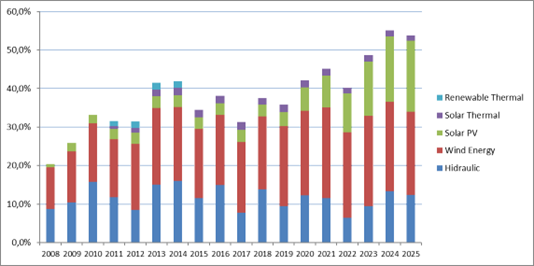
From a generation perspective, 2025 was a record-breaking year as renewables accounted for almost 54% of Spain’s national mix, with solar PV alone covering more than 18% of total energy demand. Economically, the year saw an average electricity price of €65.5/MWh, and notably, again, no new auctions for PV generation were conducted.
Participants
Task - 1
Task - 12
Centre for Research on Energy, Environment and Technology (CIEMAT)
Carmen ALONSO-GARCIA
University of Murcia
Nieves ESPINOSA
Task - 13
National Renewable Energy Centre of Spain (CENER)
Javier DIAZ BERRADE
Task - 15
Becquerel Institute Spain
Centre for Research on Energy, Environment and Technology (CIEMAT)
Ana MARCOS CASTRO
Nuria MARTIN CHIVELET
Tecnalia
Daniel VALENCIA
Nerea OTAÑO-ARAMENDI
Susana SANTAMARIA FERNANDEZ
Xabier OLANO AZKUNE
Task - 16
Centre for Research on Energy, Environment and Technology (CIEMAT)
Jesús POLO
Jose L. BALENZATEGUI
Mactech
Marco CONY
National Renewable Energy Centre of Spain (CENER)
Ana GRACIA AMILLO
Carlos FERNÁNDEZ
Public University of Navarra (UPNA)
Ignacio GARCIA
Jose Luis TORRES
Marian DE BLAS
University of Almeria
Joaquin Alonso MONTESINOS
University of Jaen
David POZO VAZQUEZ
University of Las Palmas de Gran Canaria
Albert Oliver SERRA
Luis MAZORRA AGUIAR
University of Malaga
Jose Antonio RUIZ ARIAS
University of Sevilla
Manuel SILVA
Sara MORENO
Task - 17
Task - 18
Trama Tecno Ambiental
Jorge ORTIZ
Xavier VALLVE
Task - 20
National Hydrogen Centre (CNH2)
Carlos MERINO RODRIGUEZ
Task - 19
University of Castilla La Mancha
Andrés HONRUBIA ESCRIBANO
University of La Laguna