September 2026
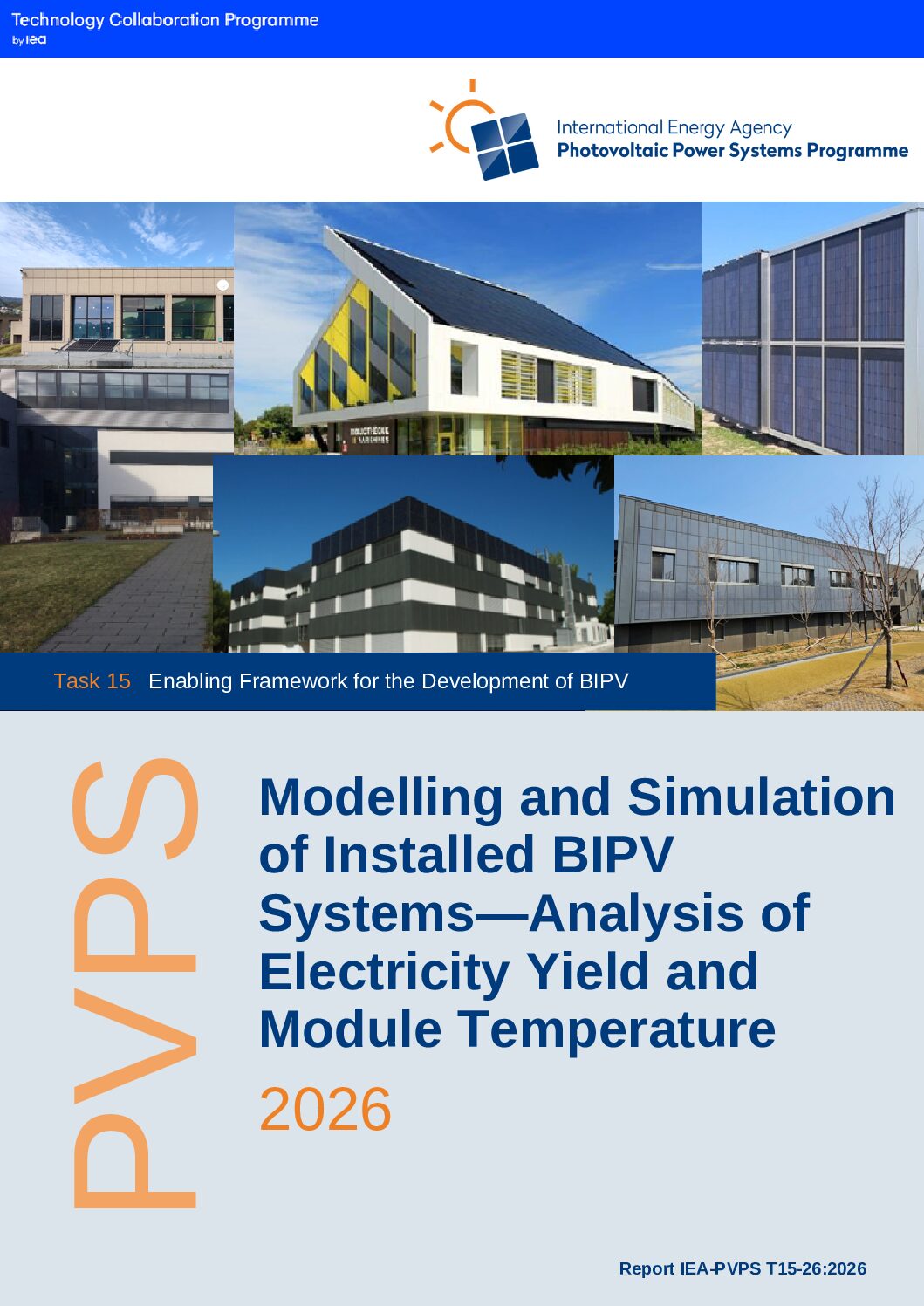
IEA PVPS has published a new report, Modelling and Simulation of Installed BIPV Systems – Analysis of Electricity Yield and Module Temperature, examining how well established PV simulation tools and temperature models can assess the electrical and thermal performance of building-integrated PV (BIPV) systems.
The report draws on measured data from six BIPV installations in Canada, Denmark, Germany, Spain, South Korea and China, covering different climates and configurations, including roof-, façade- and window-integrated systems. Simulations using the System Advisor Model (SAM) were compared with measured DC and AC power and energy data, while commonly used PV temperature models were assessed against measured module temperatures.
The findings show that established PV modelling tools can provide reasonably accurate estimates of long-term BIPV electricity yield, but that accurately modelling temperature and short-term performance remains challenging. The results also provide real-world evidence on high-temperature operation and have contributed to a more differentiated treatment of BIPV systems in IEC TS 63126.
Key highlights:
· Established PV simulation tools can estimate long-term electricity yield of BIPV systems reasonably well, but show limitations for short-term performance and thermal behaviour.
· Temperature modelling remains the main source of uncertainty for BIPV, with common PV temperature models and assumptions often failing to reflect BIPV-specific mounting and ventilation conditions.
· Measured data show that only truly insulated-back BIPV systems reach high operating temperatures, demonstrating that treating all BIPV as insulated-back is overly conservative and has informed updates to IEC TS 63126.