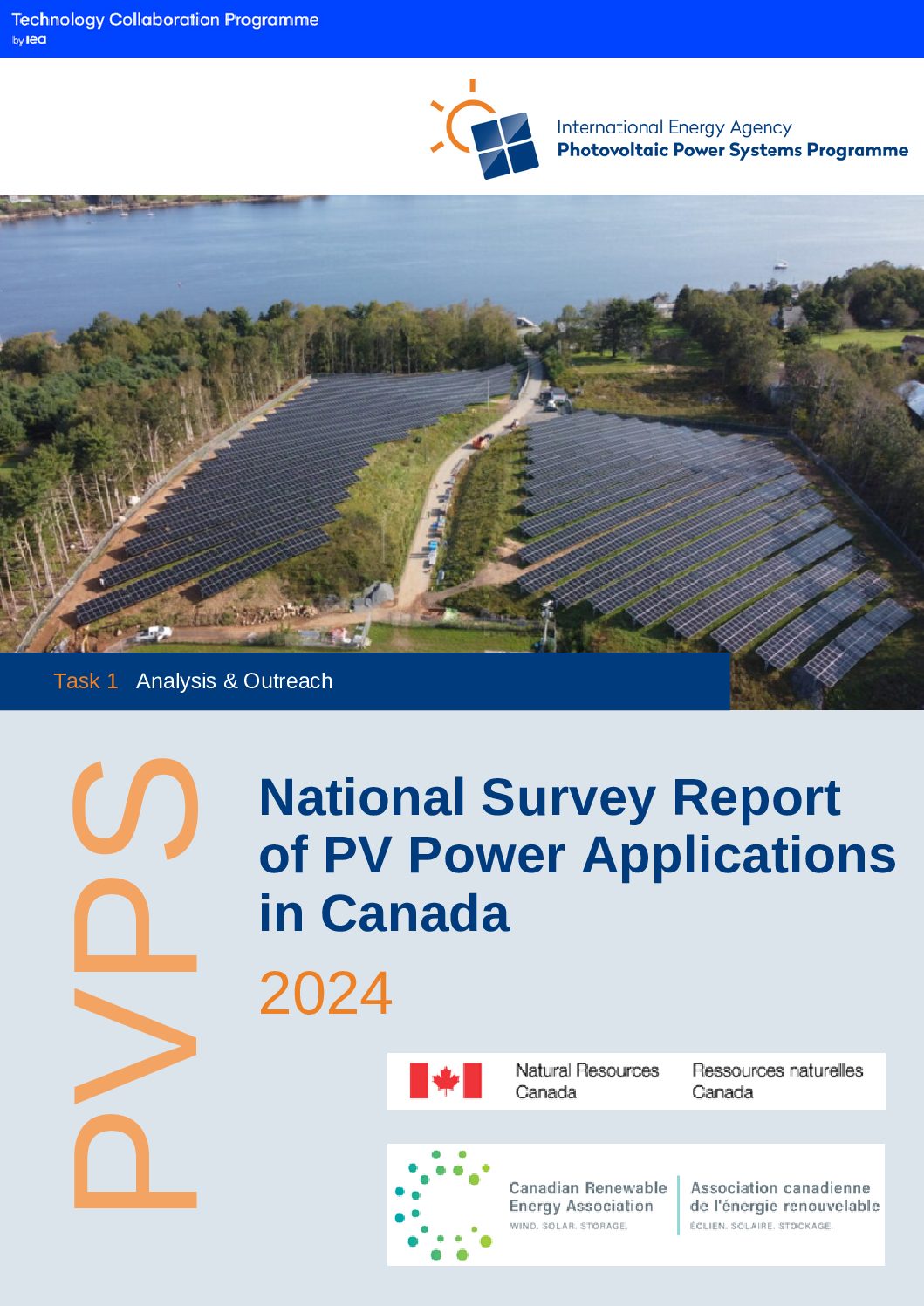
IEA PVPS Task 1 has published the National Survey Report of PV Power Applications in Canada 2024. The report provides a detailed overview of PV market development, policy frameworks, system prices, industry structure, and the role of PV in Canada’s energy system during 2024.
By the end of 2024, Canada’s cumulative installed PV capacity reached 5.29 GWAC, representing year-on-year growth of approximately 5%. Around 248 MWAC of new PV capacity was added during the year, with distributed PV accounting for the majority of new installations (223 MWAC), while centralised PV contributed 24 MWAC. Approximately 68% of Canada’s total PV capacity is centralised, reflecting the continued importance of large-scale ground-mounted systems.
PV electricity production in Canada was estimated at 8.45 TWh in 2024, covering 1.42% of total national electricity consumption, up from 1.37% in 2023. The total number of installed grid-connected PV systems across the country is estimated at more than 107 000, with Ontario and Alberta together accounting for around 90% of cumulative installed capacity.
The report highlights continued competitiveness of PV in Canada. While module prices declined further in 2024, driven by global oversupply and technological shifts toward high-efficiency bifacial modules, overall system prices remained broadly stable compared to the previous year due to higher costs for racking and balance-of-system components. Typical turnkey prices ranged from 2.30–3.90 CAD/W for residential rooftop systems and fell below 1.31 CAD/W for large utility-scale PV projects.
Canada’s policy and market landscape for PV remains highly decentralised, with provincial and territorial governments playing a central role. In 2024, PV deployment continued to be supported through a combination of net metering, capital subsidies, tax incentives, and community solar programmes, alongside federal investment tools such as the Clean Technology Investment Tax Credit. The report also notes growing interest in community-owned PV projects, particularly in provinces such as Nova Scotia and British Columbia.
From an economic perspective, PV continued to contribute to employment and industrial activity. The Canadian PV sector supported an estimated 6 500 full-time jobs in 2024, primarily in manufacturing, installation, and related services, while the total business value associated with PV installations reached approximately CAD 863 million.
The report concludes that while PV growth in Canada remains steady, significantly higher deployment levels will be required to meet long-term electrification and decarbonisation needs, particularly in sectors such as transport, buildings, and industry.