September 2026
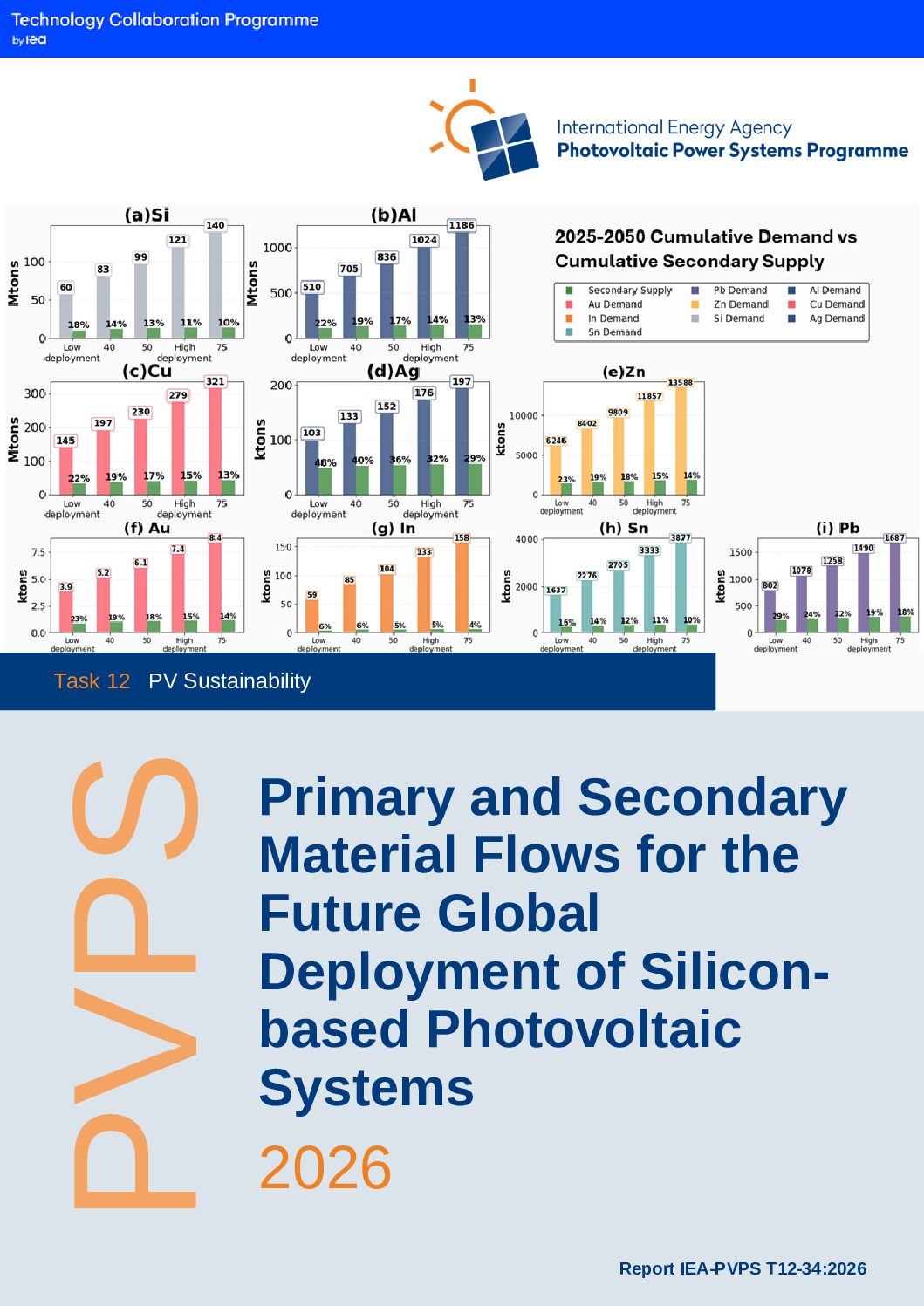
IEA PVPS has published a new report, Primary and Secondary Material Flows for the Future Global Deployment of Silicon-based Photovoltaic Systems, examining how the rapid expansion of PV could affect demand for key raw materials through 2050 and the potential contribution of materials recovered from retired PV systems.
The report models future material demand, in-use stocks and end-of-life flows for silicon-based PV under deployment scenarios ranging from 29 TWp to 75 TWp by 2050. It covers nine key materials – aluminum, copper, indium, lead, silicon, silver, gold, tin and zinc – while accounting for technological developments, material efficiency and substitution.
The findings show that while PV deployment growth is the main driver of future material demand, technology choices and increased circularity can play an important role in reducing pressure on critical resources.
Key highlights:
· Technology choices are critical for silver and indium: A sensitivity analysis confirms that future PV capacity growth is the main driver of demand for most materials. For silver, increased substitution with copper-based metallization could substantially reduce demand, while indium-based technologies would need to remain well below 20% market share to support terawatt-scale annual silicon-based PV production within current resource constraints.
· Tin demand could represent a significant share of global reserves: Cumulative PV demand for tin between 2025 and 2050 could amount to 30–64% of estimated global tin reserves, depending on future PV deployment.
· Retired PV systems could become an important secondary source of silver: Silver contained in future End-of-Life PV modules could potentially supply 30–45% of cumulative PV-sector silver demand between 2025 and 2050, highlighting the potential value of recovering materials from end-of-life systems.