December 2025
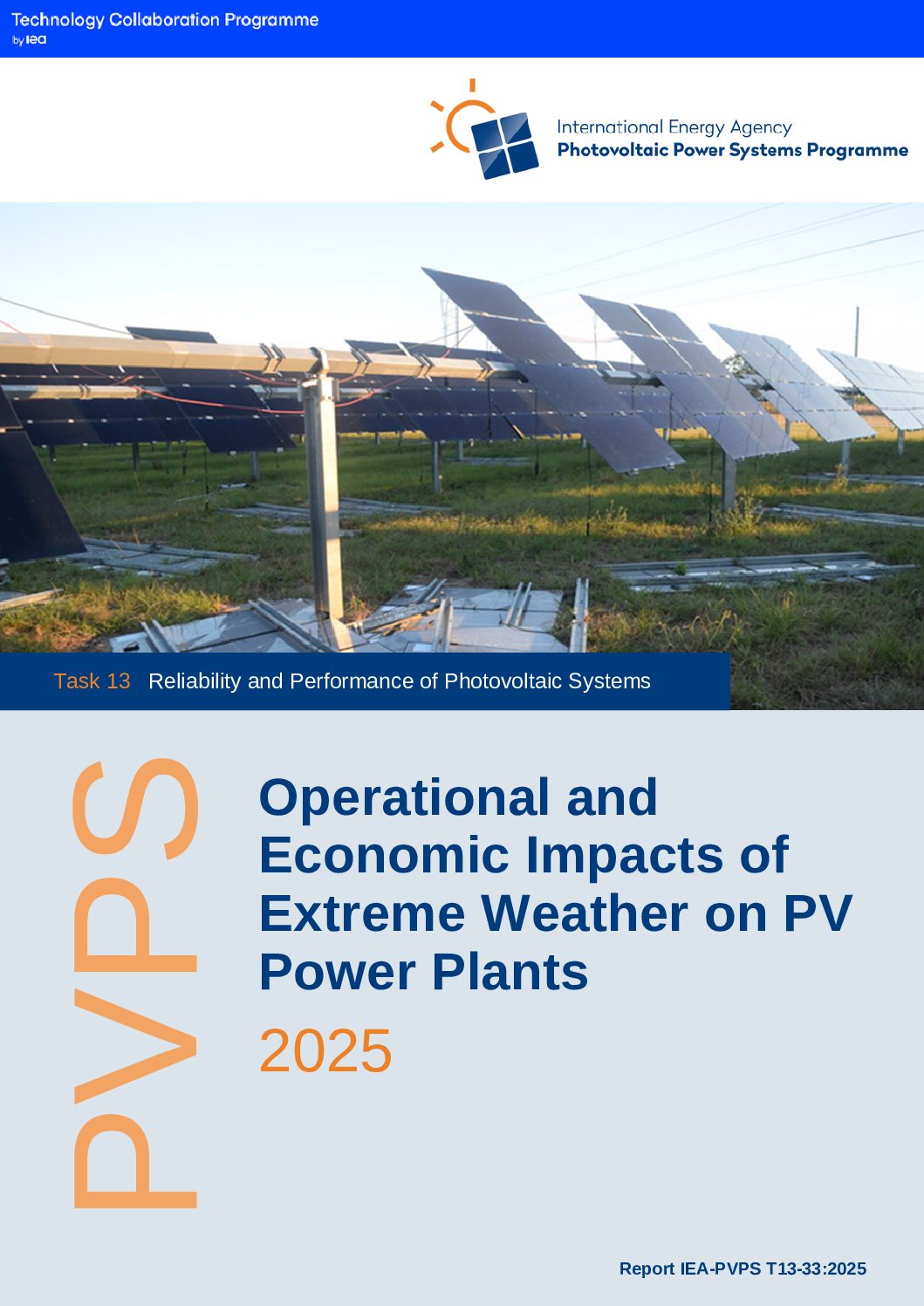
IEA PVPS has published a new Task 13 report examining the operational and economic impacts of extreme weather on photovoltaic power plants. As extreme weather events become more frequent and severe, and global PV capacity continues to grow rapidly, understanding and addressing weather-related risks is increasingly important.
The report provides a comprehensive overview of extreme weather events that are most relevant for PV systems, including tropical cyclones, convective storms and hail, snowfalls, dust and sandstorms, heatwaves, floods and wildfires. It assesses both catastrophic damage, such as the destruction of modules or mounting structures, and sub-catastrophic damage that may not be immediately visible but can lead to accelerated performance degradation over time.
Key takeaways:
1. Most PV plants can survive most extreme weather events, if appropriately sited, designed and maintained.
2. This report considers weather events that 1) have short-term impacts and occur sporadically, e.g., tropical cyclones, convective storms (including hail) and 2) those that have longer-term impacts and tend to be repetitive, e.g., snow, dust storms, heatwaves, and wildfires. From an impact perspective, two types of damage can be identified in PV systems: acute and chronic. Risk assessment for PV plants in the first category is a critical first step, whereas design optimization for plants in the second is the priority. From a resilience and mitigation standpoint, site planning is essential. Risk assessment based on a review of historical weather data and the probability of future extreme weather events for each location is crucial and must be addressed in the design phase. Once the threat landscape has been properly assessed, project developers, and owners must make informed design and procurement choices. All materials and structural components must be code-compliant; module architecture also matters, as in, modules specifically designed for hail resilience. In addition, review of the racking/tracking design, including hardware, by an independent engineer is strongly encouraged. In addition, architects should pay close attention to the terrain and geological conditions at the proposed site. For example, when installing a PV system on sloped ground, the foundation should include features to prevent landslides triggered by tropical cyclones or flooding.
3. Site owners and operators should keep relevant commissioning documents, particularly those related to energy production in order to have a baseline against which future performance can be compared. Similarly, any electroluminescent (EL) and infrared (IR) images, along with records of visual inspections and I-V measurements, should be preserved.
4. Electrical performance data are essential for evaluating the effects of extreme weather events and any resulting acceleration in system degradation. When combined with weather data-such as temperature, solar irradiation, and wind speed-this information forms time-series data that can help detect weather-related damage. Awareness among site owners and maintenance teams needs to increase regarding the importance of collecting and preserving these data.
5. Robust operation and maintenance (O&M) protocols are essential. Defects left unresolved after storm exposure may worsen over time when exposed to additional environmental stressors like heat, wind, and moisture. Continuous monitoring of power output from restored PV systems is therefore critical to ensure their performance and reliability. If a significant drop in power generation is detected, the collected data will help the owner make informed decisions about further actions, such as system refurbishment.
6. Proactive maintenance is equally important and should be tailored to the probability of risk. Before a tropical cyclone, for example, tasks such as checking the t tightness of fasteners and clearing debris, which could become airborne-should be carried out in advance.
7. If damage from extreme weather does occur, corrective maintenance should be implemented as soon as possible. Immediate steps include 1) ensuring the safety of the site by disconnecting it from the grid and opening all breakers; and 2) conducting electrical and mechanical inspections of the affected PV system. Damaged equipment should be left in situ, pending insurance or other claim-related inspections but all damaged PV modules and electrical components must be replaced prior to re-energization.
By consolidating international experience and best practices, the report supports PV developers, owners and operators in improving the resilience and long-term reliability of PV power plants under increasingly challenging climatic conditions.