August 2026
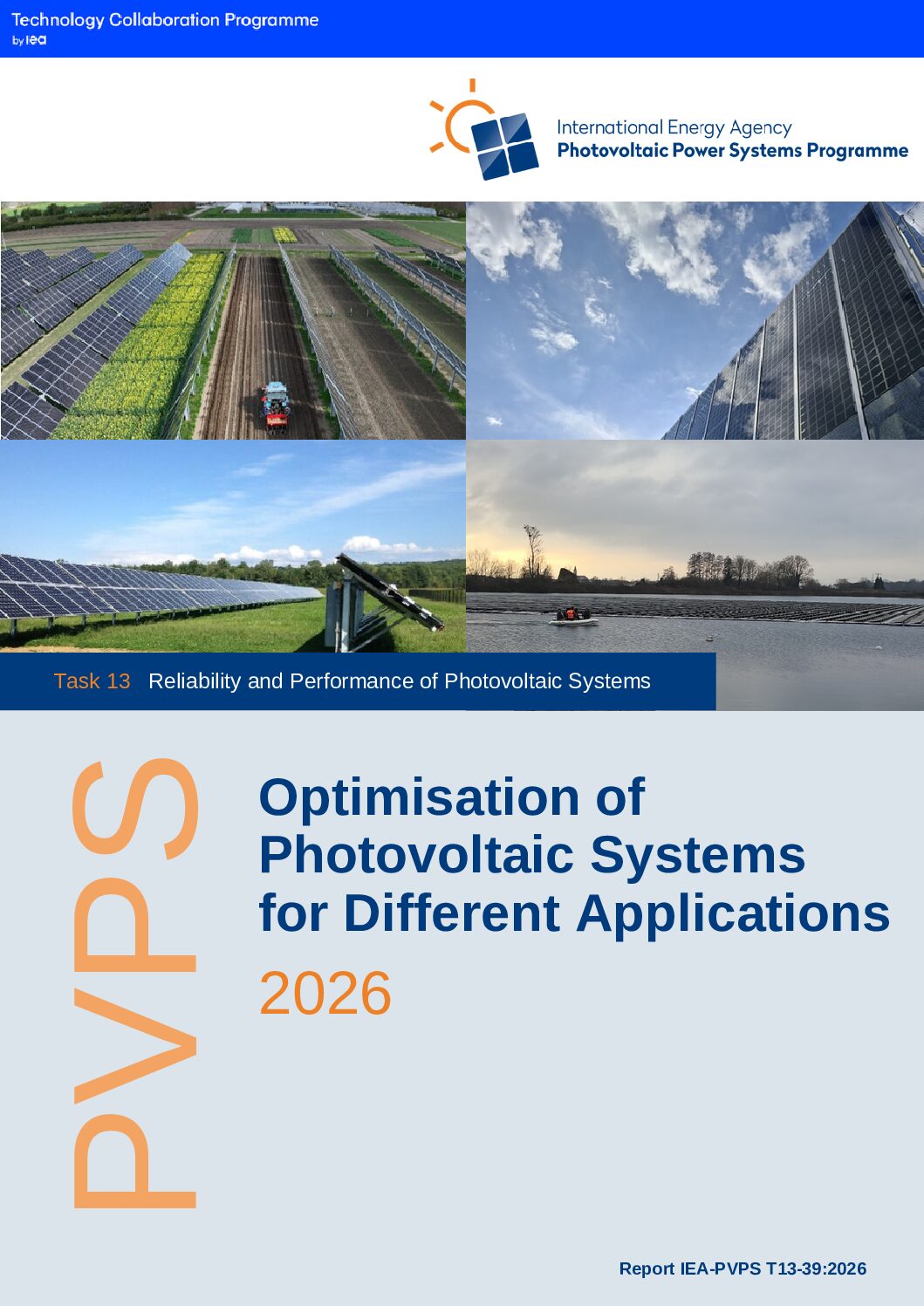
This report examines building-integrated photovoltaics (BIPV), floating photovoltaics (FPV) and agrivoltaics (AV), focusing on how application-specific environmental conditions and functional requirements affect PV performance, reliability and lifetime. The report argues that conventional design approaches developed primarily for ground-mounted PV are not sufficient for these applications, which require a broader, multidimensional approach to performance assessment.
The report covers application-specific module energy yield and performance loss rates, as well as optimisation strategies for site assessment, component selection, system design, monitoring and operation. It also reviews the applicability of existing energy-rating methodologies and highlights the need for representative testing and additional field data for integrated PV applications.
Key takeaways:
- Standard PV design rules don’t apply to new applications: BIPV, FPV and agrivoltaics face different stressors and functional requirements, from fire and structural requirements in buildings to water exposure, corrosion and shared land use. Applying conventional PV assumptions can lead to faster degradation, inaccurate performance predictions and inappropriate component choices.
- Beyond energy yield and cost: Integrated PV systems are multi-purpose infrastructure, requiring a broader performance framework than energy yield or LCOE alone. Depending on the application, this includes area-specific energy yield, dual-use benefits, environmental interactions and acceptance by farmers, architects and other stakeholders.
- Early results are promising, but standards need to catch up: Early field evidence suggests that well-designed FPV and AV systems can achieve lifetimes comparable to conventional PV, but long-term data remain limited. Existing testing standards also do not fully capture application-specific conditions, highlighting the need for further field data and adapted testing and benchmarking approaches.
As the report’s authors explain, “integrated PV systems require design approaches that go beyond those developed for conventional ground-mounted PV systems, and should be understood as multifunctional infrastructure rather than stand-alone energy assets.”