February 2026
This report assesses the unique environmental, technical and economic conditions affecting PV deployment above 60°N latitude and provides guidance for reliable, climate-adapted system design.
“Far from being unsuitable for solar energy, the Greater Arctic holds untapped potential for photovoltaics to strengthen energy security, enhance resilience in remote communities, and deliver reliable, low-carbon power – even under the most extreme climatic conditions,” says Joshua Stein, one of the main authors.
Key Takeaways
1. High-latitude solar resources are characterized by high seasonality, low sun elevations and wide azimuth angle variations, meaning fixed arrays experience extended periods with the sun behind the modules compared to lower latitudes.
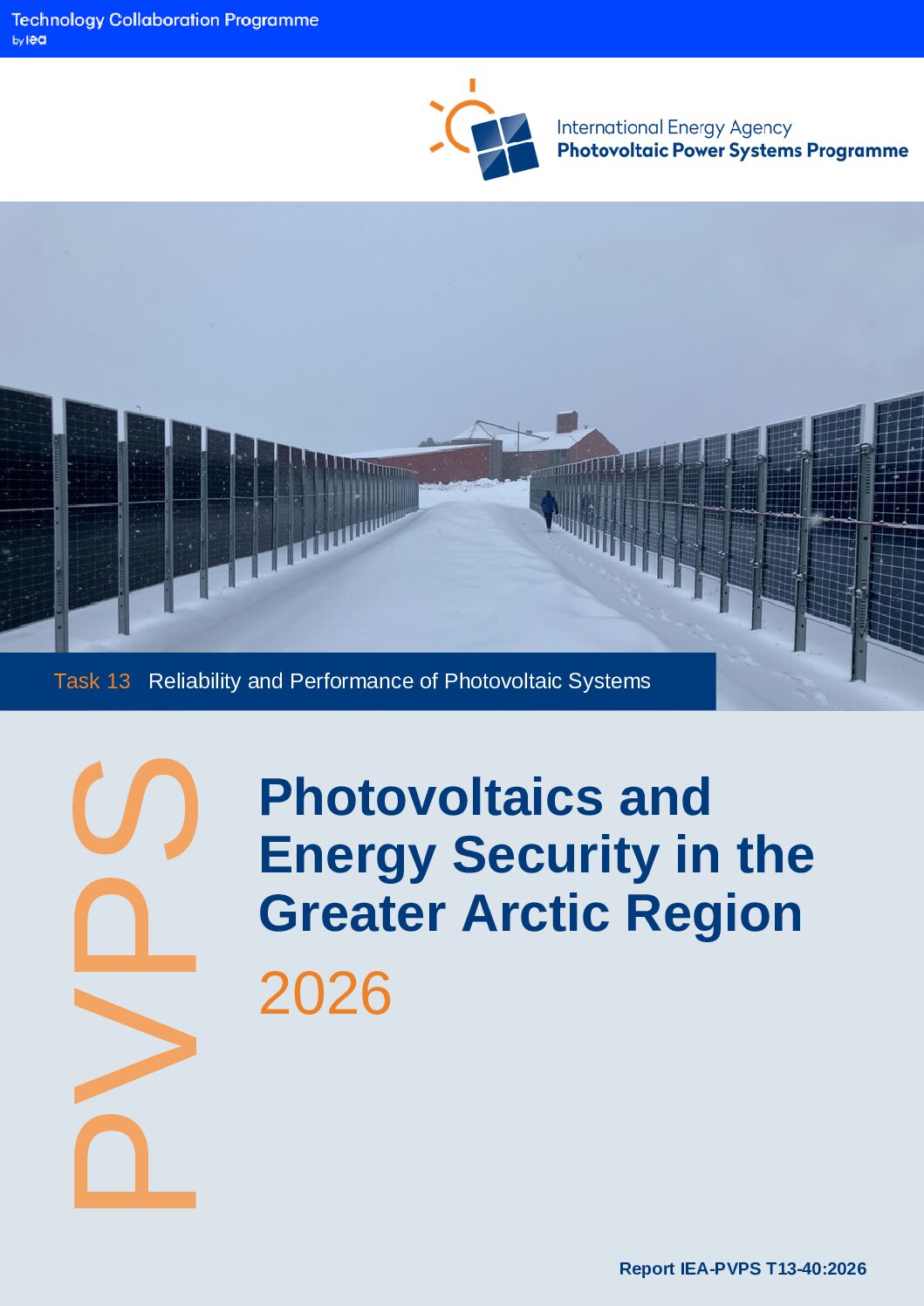
2. Bifacial modules and vertical PV arrays offer significant performance advantages by capturing more direct, diffuse and reflected light, while also improving snow shedding.
3. While lower temperatures enhance PV efficiency and may slow degradation, Arctic installations require tailored designs – frost-resistant foundations, snow-aware layouts and adapted system engineering – to ensure long-term reliability; encouragingly, several Arctic countries are already deploying PV with climate-specific solutions.
The report further highlights the importance of high-quality solar resource and albedo data, improved modelling approaches for snow losses, and careful geotechnical assessments in permafrost regions. It concludes that, with climate-adapted engineering and robust performance analysis, PV can make a meaningful contribution to Arctic energy systems.