16Solar Resource for High Penetration and Large Scale Applications

Task Managers

Task 16 provides access to comprehensive international studies and experiences with solar resources and forecasts. It supports different stakeholders from research, instrument manufacturers as well as private data providers and utilities.

Task 16 is a joint Task with the TCP SolarPACES (Task V). It collaborates also with the Solar Heating and Cooling (SHC) and with Wind Task 51.

Current Focus Topics

As in the first two phases also for the 3rd phase the main result of Task is the update of the Solar Resource Handbook. This last version (4th edition) has been published in October 2024. It includes the major results of the collaboration during the years 2020 - 2024 (Sengupta et al., 2024a and Sengupta et al., 2024b).

The team worked on the following topics:

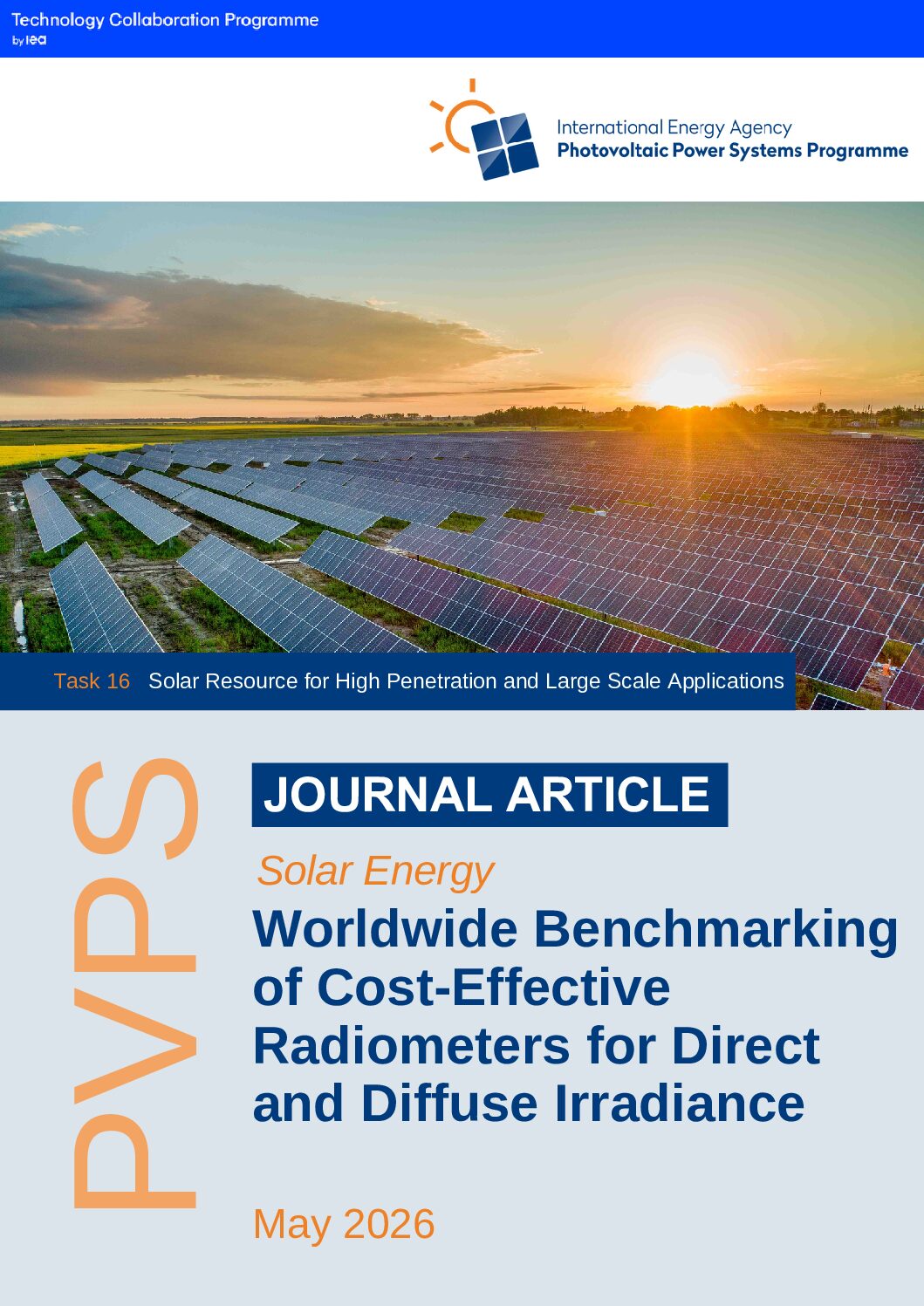
  1. Scientific Paper on comparison of simple diffuse or direct radiation measurement options. The paper is in 2nd review and should be published in spring 2026.
  2. Scientific Paper of results of climate models regarding changes of radiation parameters (state: draft).
  3. Three benchmarks of solar forecasts based on all sky imagers, satellite data and day ahead forecasts are ongoing. The benchmarks will be published in 2027 in the form of papers and reports.
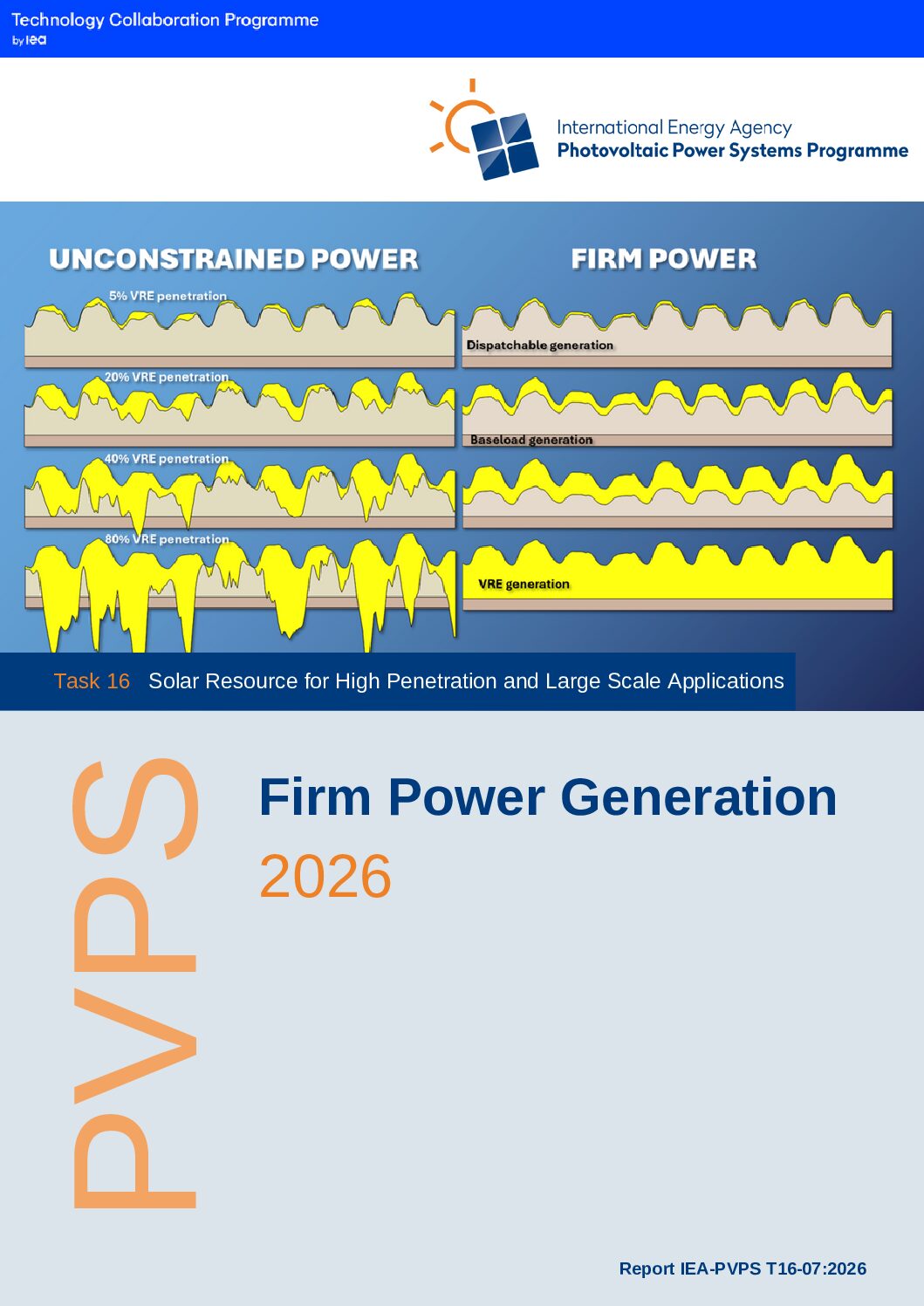
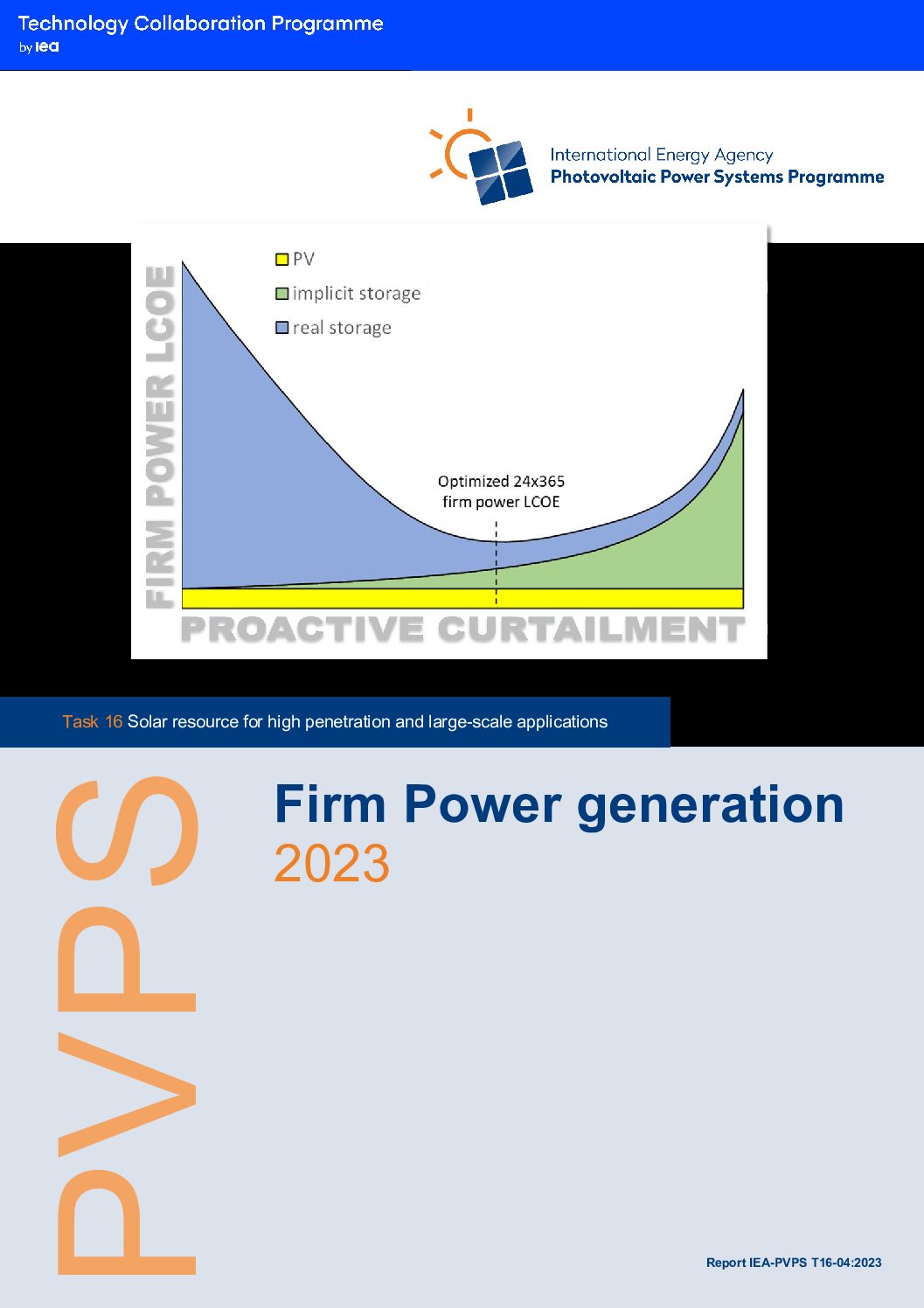
  4. Update of first Firm power generation report (Firm Power Generation 2026). The report is foreseen for February 2026.
Read more
2025 Accomplishments

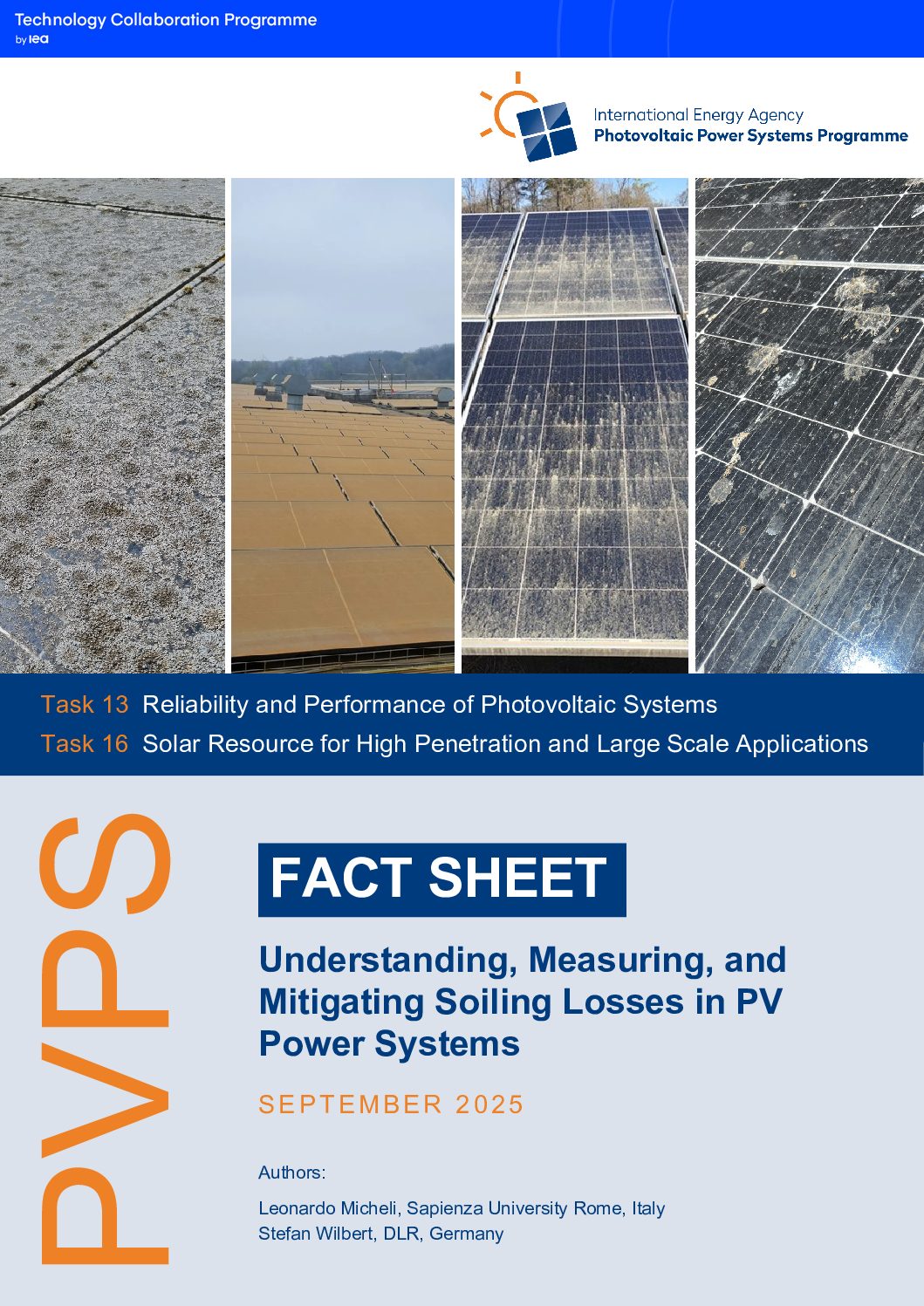
Four publications were published in 2025 —three within Task 16 and one in collaboration with Task 13 (Factsheet on soiling).

Additionally, six further scientific papers have been published in 2025:

  • Blum, Niklas, et al., 2025: “Geometric calibration of all-sky cameras using sun and moon positions: A comprehensive analysis.” Solar Energy 295 (2025): 113476.
  • Bonanno, R. and E. Collino, 2025: Assessing the impact of climate change on solar energy production in Italy, Reg. Environ. Change, vol. 25, fasc. 3, p. 78, July 2025, doi: 10.1007/s10113-025-02417-6.
  • Honningdalsnes, Erlend Hustad, Erik Stensrud Marstein, Dag Lindholm, Helge Bonesmo, Heine Nygard Riise, 2025: Wind sheltering in vertical agrivoltaics can increase crop yields: A modeling study for Northern Europe, Energy Nexus, Volume 19, 2025, 100516, ISSN 2772-4271,
    https://doi.org/10.1016/j.nexus.2025.100516
  • Meddahi, A., Tuomiranta, A., & Guillon, S., 2025: Skill-Driven Data Sampling and Deep Learning Framework for Minute-Scale Solar Forecasting with Sky Images. Solar RRL, 9, 2400664. https://doi.org/10.1002/solr.202400664
  • van Eldik, Ruben and Wilfried van Sark, 2025: Firm wind and solar photovoltaic power with proactive curtailment: A European analysis, Energy Conversion and Management, Volume 347, 2026,120399, ISSN 0196-8904, https://doi.org/10.1016/j.enconman.2025.120399
  • Sohani, Ali, Marco Pierro, David Moser, and Cristina Cornaro, 2025: Comparison of Physical Models for Bifacial PV Power Estimation. Journal Energy Conversion and Volume 327, 2025, 119515, ISSN 0196-8904, https://doi.org/10.1016/j.enconman.2025.119515.

Two workshops were held as side events for the Task workshops in spring and autumn:

  • A public workshop organized by LMD, Univ. Palaiseau, was held in the conjunction with the Task meeting. Topic: ” Journée De meilleures données solaires pour booster le photovoltaïque” (Palaiseau, Paris, April 4th 2025)
  • A workshop on invitation about “VRE renumeration models adequate for firm power” was held in Neuchatel, Switzerland, in collaboration with IEA PVPS Task 19 (JRA-40) (October 17th, 2025).

At two internal workshops, the new work plan for the period of July 2026 – June 2029 has been developed. Task 16 members started also the activity to update and enhance Wikipedia entries regarding solar irradiance. Some updates were successful for:

Read more
Objectives

The main goals of Task 16 are to lower barriers and costs of grid integration of PV and to lower planning and investment costs for PV by enhancing the quality of the forecasts and the resources assessments. Solar resources are introducing the highest share of uncertainty in yield assessments.

To reach this main goal the Task has the following objectives:

  • Lower uncertainty of satellite retrievals and Numerical Weather Prediction
  • Define best practices for data fusion of ground, satellite and NWP data (re-analysis) to produce improved datasets, e.g. time series or Typical Meteorological Year.
  • Develop enhanced analysis for e.g. point to area forecasts, solar trends, albedo, solar cadastres and firm PV power.
  • Contribute to or setup international benchmark for data sets and for forecast evaluation.

The scope of the work in Task 16 concentrates on meteorological and climatological topics needed to plan and run PV, solar thermal, concentrating solar power stations and buildings

The work programme of Task 16 addresses from scientific meteorological and climatological issues to high penetration and large scale PV in electricity networks, and also includes a strong focus on user needs. Dissemination and user interaction is foreseen in many different ways from workshops and webinars to paper and reports and online code archives or Wikipedia.

Read more

Subtasks

1Subtask 1 : Methodologies for resource data generation

  • Radiation measurements
  • Radiation models
  • Benchmarking solar datasets
  • Additional meteorological parameters

2Subtask 2 : Enhancement of data & value-added products

  • Data quality and format
  • Climate change and long-term variability
  • Products for the end-users
  • Products for upcoming, integrated technologies

3Subtask 3 : Solar forecasting

  • PV power forecasting at different spatio-temporal scales
  • Probabilistic solar forecasting
  • Cloud image based nowcasting (0-6 hours)
  • Firm power generation

4Subtask 4 : Dissemination and Outreach

  • Webinars, workshops, publications and training
  • Update of the solar resource handbook
  • Practical guide to solar data processing and modelling
  • Update basic knowledge for a broad public (e.g Wikipedia)

Outreach

The work programme of the proposed Task 16 addresses on one side scientific meteorological and climatological issues to high penetration and large scale PV in electricity networks, but also includes a strong focus on user needs and for the first time a special dissemination subTask. Dissemination and user interaction are foreseen in many different ways from workshops and webinars to paper and reports.


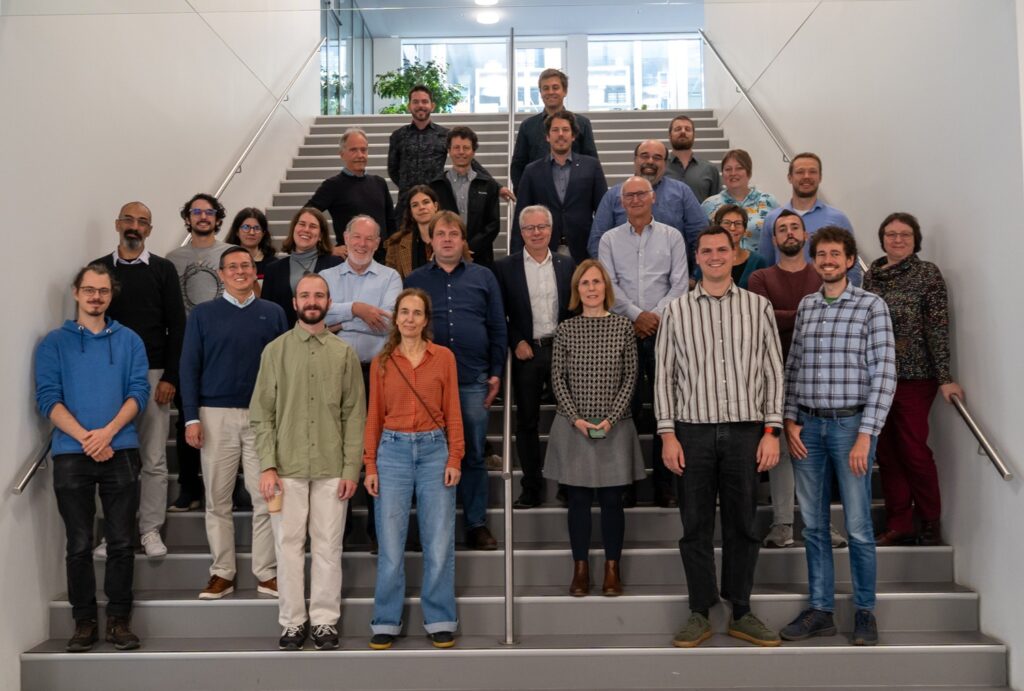
The project requires the involvement of key players in solar resource assessment and forecasting at the scientific level (universities and research institutions) and commercial level (companies). A consortium of 51 institutions of 19 countries has been formed. This includes large science centres like DLR, NREL or Fraunhofer, universities like State Univ. of New York, Mines ParisTech or Univ. of Jaen, national weather services like DWD, BOM or DMI and data providers like Solargis, Vaisala or Meteotest.

Task 16 Reports